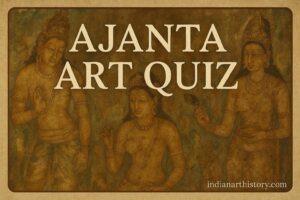

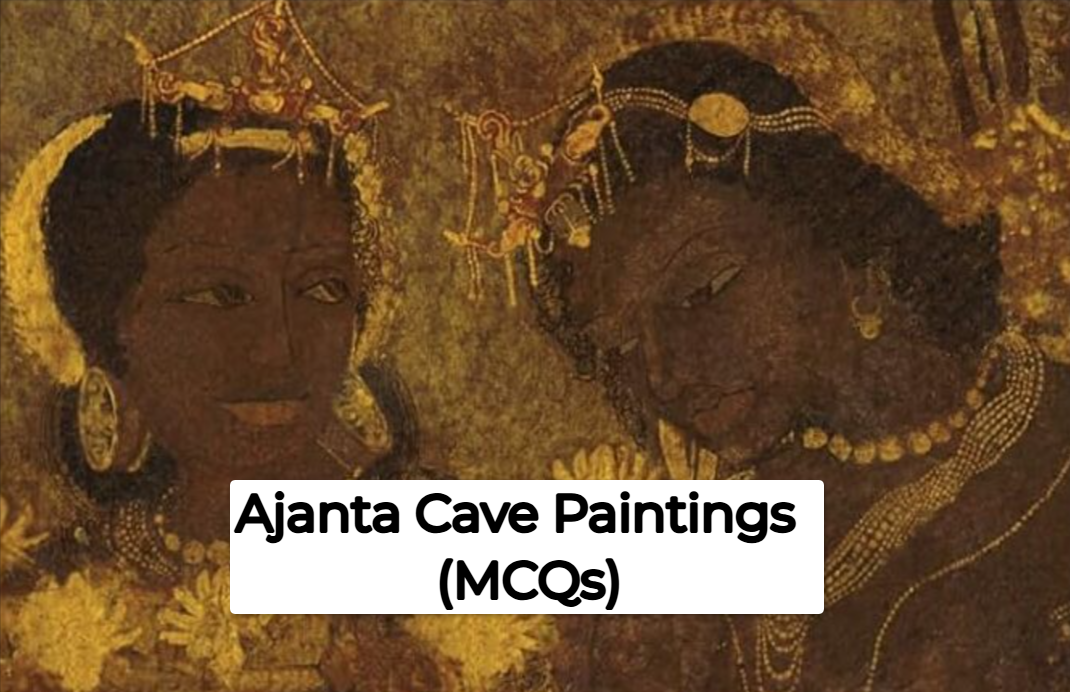
100 multiple choice questions (MCQs) about Ajanta Cave Paintings, divided into categories
Table of Contents
🏛️ General Information
- Where are the Ajanta Caves located?
A) Maharashtra
B) Karnataka
C) Gujarat
D) Madhya Pradesh
Answer: A - Ajanta Caves are famous for which type of artwork?
A) Sculptures
B) Pottery
C) Paintings
D) Carpets
Answer: C - How many caves are there in Ajanta?
A) 20
B) 28
C) 30
D) 35
Answer: C - Ajanta Caves are a part of which mountain range?
A) Himalayas
B) Vindhyas
C) Sahyadris
D) Satpura
Answer: C - Which river flows near the Ajanta Caves?
A) Krishna
B) Godavari
C) Waghora
D) Narmada
Answer: C
🕰️ Historical Context
- When were the Ajanta Caves discovered by the British?
A) 1819
B) 1900
C) 1850
D) 1785
Answer: A - Who discovered the Ajanta Caves?
A) John Smith
B) Alexander Cunningham
C) James Prinsep
D) William Jones
Answer: A - Which emperor’s reign is associated with the later Ajanta caves?
A) Ashoka
B) Harsha
C) Kanishka
D) Harisena
Answer: D - Which dynasty is responsible for the patronage of the later caves of Ajanta?
A) Maurya
B) Satavahana
C) Vakataka
D) Gupta
Answer: C - Ajanta caves were mainly used as:
A) Military Camps
B) Jain Monasteries
C) Buddhist Monasteries
D) Royal Palaces
Answer: C
🖌️ Art and Paintings
- What painting technique was used in Ajanta?
A) Tempera
B) Fresco
C) Oil
D) Watercolor
Answer: B (Fresco-secco technically) - What materials were used to prepare colors in Ajanta paintings?
A) Natural Minerals
B) Synthetic Chemicals
C) Crude Oil
D) Plastic Derivatives
Answer: A - The Ajanta paintings mostly depict stories from:
A) Mahabharata
B) Ramayana
C) Jataka Tales
D) Puranas
Answer: C - What is the main subject of Ajanta paintings?
A) Nature
B) Warfare
C) Buddha’s life and teachings
D) Hindu gods
Answer: C - Which of the following is a famous painting from Ajanta?
A) Bodhisattva Padmapani
B) Krishna Leela
C) Gita Updesh
D) Arjuna’s Penance
Answer: A
🏛️ Architecture & Layout
- Cave 1 at Ajanta is especially famous for the murals of which two Bodhisattvas flanking its doorway?
A) Manjushri and Avalokiteshvara
B) Padmapani and Vajrapani
C) Maitreya and Samantabhadra
D) Tara and Kshitigarbha
Answer: B - Which cave is the largest vihāra (monastic hall) at Ajanta but remains unfinished?
A) Cave 2
B) Cave 4
C) Cave 6
D) Cave 11
Answer: B - The Ajanta Caves were carved into which type of rock?
A) Limestone
B) Granite
C) Basalt (volcanic trap)
D) Sandstone
Answer: C - Cave 9 is classified architecturally as a:
A) Mahā-stūpa
B) Chaitya-griha (prayer hall)
C) Gṛiha-patrika
D) Mandapa
Answer: B - The vaulted ceiling with ribbed stone imitation of wooden beams is a key feature of:
A) Cave 19
B) Cave 25
C) Cave 15
D) Cave 3
Answer: A - Which cave contains a colossal reclining Buddha representing Mahāparinirvāṇa (the Buddha’s passing)?
A) Cave 21
B) Cave 24
C) Cave 26
D) Cave 12
Answer: C - How many chaitya halls exist among the thirty caves?
A) 2
B) 3
C) 4
D) 5
Answer: B (Caves 9, 10, 19) - The cloistered verandah with ornate columns and painted wall panels is characteristic of which major vihāra?
A) Cave 6 (upper)
B) Cave 2
C) Cave 17
D) Cave 28
Answer: B - Most Ajanta caves face which cardinal direction, taking advantage of natural light?
A) North
B) South
C) East
D) West
Answer: D - Cave 8 is unique because it lacks:
A) Inner sanctum (garbha-gṛiha)
B) Decorative pillars
C) Paintings
D) A façade porch
Answer: C
🖋️ Iconography & Narrative Themes
- Ajanta murals predominantly illustrate stories from the:
A) Panchatantra
B) Bhagavata Purāṇa
C) Jātaka Tales
D) Arthashastra
Answer: C - The “Mahajanaka Jātaka” narrative is painted mainly in:
A) Cave 16
B) Cave 2
C) Cave 10
D) Cave 27
Answer: A - Which Jātaka tells the tale of a self-sacrificing Bodhisattva king who offers his flesh to a starving tigress?
A) Shyama Jātaka
B) Vessantara Jātaka
C) Ruru Jātaka
D) Simhala-Avadāna
Answer: B - The painting of the “Dying Princess” scene belongs to:
A) Chaddanta Jātaka
B) Hasti Jātaka
C) Mahāsumedha Jātaka
D) Mahājanaka Jātaka
Answer: D - In Cave 17 a dramatic depiction of Prince Simhala being rescued from ogresses appears. Which literary source is that?
A) Lalitavistara
B) Avadāna-śataka
C) Simhala-Avadāna
D) Divyāvadāna
Answer: C - The painting of King Bimbisāra paying homage to the Buddha can be seen in:
A) Cave 6
B) Cave 1
C) Cave 17
D) Cave 20
Answer: B - The “Temptation of Mara” is depicted with demons trying to distract the Buddha in:
A) Cave 19
B) Cave 26
C) Cave 14
D) Cave 22
Answer: B - Which Bodhisattva is often shown holding a blue lotus (utpala) in Ajanta?
A) Vajrapani
B) Padmapani
C) Lokeshvara
D) Maitreya
Answer: B - The regal, crown-wearing Buddha images at Ajanta signal the rise of:
A) Esoteric Vajrayāna practice
B) Bodhisattva ideal in Mahāyāna
C) Hinayāna orthodoxy
D) Shaivite influence
Answer: B - Animals such as elephants, peacocks, and swans appear frequently because they symbolize:
A) Fertility and wealth
B) Royal court life
C) Moral virtues and cosmological guardians
D) Zodiac signs
Answer: C
🎨 Techniques & Materials
- The pigment binders in Ajanta murals mainly used which medium?
A) Egg tempera
B) Lime water (fresco-secco)
C) Linseed oil
D) Animal glue
Answer: B - Lapis lazuli imported from Afghanistan was primarily used to obtain which color?
A) Deep red
B) Emerald green
C) Ultramarine blue
D) Bright yellow
Answer: C - Which mineral supplied the yellow ochre seen in many Ajanta panels?
A) Hematite
B) Goethite
C) Malachite
D) Cinnabar
Answer: B - Surface preparation before painting involved a two-layer plaster of clay and:
A) Gypsum
B) Marble dust
C) Cow-dung and rice husk
D) Fine lime
Answer: D - Fine dark outlines in the murals were usually applied with brushes made from:
A) Crow feathers
B) Goat hair
C) Reed pens
D) Boar bristles
Answer: B - Artists created chiaroscuro (light-and-shade) modeling mainly through:
A) Hatching with charcoal
B) Superimposed translucent washes
C) Gold leaf application
D) Stippling with bone tools
Answer: B - Polishing of painted surfaces to impart a satin sheen was accomplished using:
A) River pebbles
B) Bronze spatulas
C) Beeswax cloths
D) Sandpaper
Answer: A - White highlights in Ajanta paintings often derive from:
A) Gypsum or kaolin
B) Lead white
C) Zinc oxide
D) Shell chalk
Answer: A - Comparable large-scale wall-painting traditions in early India are also found at:
A) Badami and Bagh
B) Konark and Khajuraho
C) Mahabalipuram and Ellora
D) Nalanda and Sarnath
Answer: A - The term ‘fresco-secco’ used for Ajanta means:
A) Painting on wet lime plaster
B) Painting on dry, fully-set plaster
C) Painting on stone with oil
D) Painting with tempera on cloth
Answer: B
⏳ Chronology & Patronage
- Scholars divide Ajanta’s artistic activity into two phases; Phase I belongs roughly to:
A) 2nd century BCE – 1st century CE
B) 1st – 2nd centuries CE
C) 4th – 5th centuries CE
D) 6th – 7th centuries CE
Answer: A - Phase II (the “Vākāṭaka phase”) flourished mainly under King:
A) Pravarasena II
B) Harisena
C) Rudrasena II
D) Sarvasena
Answer: B - The prime minister of King Harisena, believed to have sponsored several caves, was:
A) Varāhadeva
B) Karkarāja
C) Aniruddha
D) Bhadra
Answer: A - An inscription credits which merchant-guild with funding Cave 17 murals?
A) Silk-weavers of Paithan
B) Seafaring guild of Broach
C) Lay Buddhists of Nasik
D) Potters of Ujjain
Answer: C - Ajanta was abruptly abandoned around:
A) 450 CE
B) 477 CE
C) 550 CE
D) 619 CE
Answer: C
🛠️ Conservation & Rediscovery
- The modern rediscovery of Ajanta in 1819 was made by:
A) Major Robert Gill
B) Dr. John Smith
C) Captain Wilkins
D) Sir Thomas Daniell
Answer: B - Which British officer spent years making meticulous watercolor copies of the murals, many of which perished in a London fire?
A) James Fergusson
B) Robert Gill
C) Alexander Cunningham
D) John Marshall
Answer: B - The Archaeological Survey of India classifies Ajanta as a Monument of:
A) National Importance
B) State Heritage
C) Intangible Cultural Value
D) Endangered Sites List
Answer: A - Ajanta was inscribed as a UNESCO World Heritage Site in:
A) 1974
B) 1983
C) 1990
D) 1999
Answer: B - A major threat to the murals today is:
A) Seismic activity
B) Industrial pollution from nearby mines
C) Fluctuating humidity due to tourist influx
D) Acid rain from chemical factories
Answer: C - Laser-cleaning of soot and varnish layers was first piloted in which cave?
A) Cave 1
B) Cave 2
C) Cave 10
D) Cave 19
Answer: A - Protective glass barriers now restrict visitor proximity particularly in:
A) Cave 16
B) Cave 17
C) Cave 26
D) Caves 1 & 2
Answer: D - The ‘Visions of Buddhist Paradise’ international exhibition (1999) featured full-scale facsimiles from Ajanta created by:
A) Japanese team led by Koichi Yoshikawa
B) National Museum, New Delhi
C) Victoria and Albert Museum
D) Smithsonian Institution
Answer: A - To reduce mold growth, the ASI installed a climate-control monitoring system in what year?
A) 2001
B) 2006
C) 2013
D) 2019
Answer: B - Drone-based 3-D laser scanning of the cliff façade was first completed in:
A) 2010
B) 2015
C) 2018
D) 2022
Answer: C
✨ Stylistic Features & Aesthetics
- Ajanta figures are renowned for an S-shaped tribhanga pose derived from:
A) Gandhāran prototypes
B) Yakshi sculptures at Sanchi
C) Classical dance postures (nritya)
D) Hellenistic torsion style
Answer: C - Eyes in Ajanta portraits are typically drawn in a style termed:
A) Fish-shaped (matsya-akṣī)
B) Half-moon (ardha-candra)
C) Lotus petal (kamala-patra)
D) Almond (bādamī)
Answer: D - Transparent muslin garments are indicated through:
A) Fine white hatching over flesh tones
B) Gold outlines alone
C) Leaving the under-layer bare
D) Scratching through wet paint
Answer: A - Jewelry rendered with rhythmic dotting is a hallmark also seen later at:
A) Sittanavasal (Tamil Nadu)
B) Lepakshi (Andhra Pradesh)
C) Chola bronze art
D) Tabo monastery (Himachal)
Answer: A - Expressive hand gestures (mudrās) are crucial in conveying:
A) Narrative sequence
B) Musical rhythms
C) Agricultural cycles
D) Textile patterns
Answer: A - Architectural trompe-l’œil—painted imitation of wood or stone—is especially visible on:
A) Ceiling coffers
B) Door lintels
C) Pilaster bases
D) Floor borders
Answer: B - Perspective in Ajanta murals is achieved mainly through:
A) Linear vanishing points
B) Overlapping and diminish-in-scale figures
C) Atmospheric haze
D) Colored shadows
Answer: B - Faces of royalty often show a head-tilt and downward gaze signifying:
A) Divine compassion
B) Courtly modesty
C) Awareness of samsara
D) Sarcastic humor
Answer: B - Lotus motifs doubling as aureoles behind the Buddha indicate:
A) Abstract time cycles
B) Illumination and purity
C) Solar deities
D) Tantric chakras
Answer: B - Scenes with massed attendants in diagonally receding tiers demonstrate:
A) Influence of scroll painting
B) Proto-Renaissance perspective
C) Hierarchical space-division common in Indian art
D) Persian miniature conventions
Answer: C
🌍 Influence & Legacy
- Ajanta’s painting tradition directly inspired later works at the 6th-century Bagh Caves in:
A) Madhya Pradesh
B) Odisha
C) Rajasthan
D) Bihar
Answer: A - Ellora’s Kailāśanātha temple incorporates painted fragments echoing Ajanta’s palette in:
A) Cave 14
B) Cave 16
C) Cave 21
D) Indra-Sabha
Answer: B - Some art historians see stylistic parallels between Ajanta and the murals of:
A) Dunhuang (China)
B) Pompeii (Italy)
C) Luxor (Egypt)
D) Angkor Wat (Cambodia)
Answer: A - The Padmapani figure from Ajanta appeared on an Indian postal stamp first in:
A) 1954
B) 1963
C) 1975
D) 1985
Answer: B - Modern Indian painters of the Bengal School—like Nandalal Bose—studied Ajanta sketches made by:
A) Abanindranath Tagore
B) Sister Nivedita
C) Lady Herringham
D) Anagarika Dharmapala
Answer: C - Ajanta’s narrative sequencing has been compared to:
A) Early Japanese emakimono scrolls
B) Mayan codices
C) Greek friezes
D) Bayeux Tapestry
Answer: A - An Indo-Japanese preservation project launched in 1991 focused chiefly on:
A) Cave 2 ceiling
B) Cave 6 lower hall
C) Cave 17 Jātaka panels
D) Cave 1 portal paintings
Answer: D - UNESCO cites Ajanta as a masterpiece of which broad cultural zone?
A) The Hellenistic world
B) Indo-Islamic heritage
C) Buddhist Palae-Asian interchange
D) Rock-cut South Asian art
Answer: D - Contemporary replicas of Ajanta murals are housed in full-scale at the:
A) National Museum, Delhi
B) Chhatrapati Shivaji Maharaj Vastu Sangrahalaya, Mumbai
C) Victoria Memorial Hall, Kolkata
D) Indian Museum, Kolkata
Answer: A - Virtual-reality walkthroughs of Ajanta released in 2024 were pioneered by:
A) Google Arts & Culture in partnership with ASI
B) Archaeological Survey of Sri Lanka
C) Smithsonian 3-D Lab
D) Microsoft HoloLens Studio India
Answer: A
❓ Miscellaneous & Fun Facts
- The Sanskrit term “Ajinnaṭa,” possibly a corruption of which means ‘remote’?
A) A-jīna-ṭha
B) Ajāta-nātha
C) Ajñāta (unknown)
D) A-jina-ratha
Answer: C - The horseshoe-shaped cliff at Ajanta forms a bend of the:
A) Bhima River
B) Waghora River
C) Purna River
D) Tapti River
Answer: B - Which wildlife species is commonly sighted near the cliff today and occasionally entrances tourists?
A) Spotted deer
B) Bonnet macaque
C) Indian gaur
D) Leopard
Answer: B - Traditional access to Ajanta before modern stairs was through:
A) Pulled bamboo ladders
B) Rope bridges from the cliff top
C) A forest footpath skirting the riverbed
D) Stone-cut tunnel from behind the cliff
Answer: C - The nearest major railhead for visitors to Ajanta is:
A) Nagpur
B) Jalgaon
C) Pune
D) Nasik
Answer: B - An early 20th-century attempt to detach murals for European museums failed because:
A) Local protests halted it
B) Fresco-secco surface crumbled on removal
C) British Museum lacked funds
D) Lime plaster was too firmly bonded
Answer: B - Which year saw Ajanta closed briefly due to a large rock-fall hazard?
A) 1967
B) 1979
C) 1992
D) 2005
Answer: D - A 19th-century lithograph series of Ajanta was published in “The Cave Temples of India” by:
A) James Fergusson & James Burgess
B) Monier Williams
C) Richard Temple
D) Edwin Arnold
Answer: A - Ajanta’s cliff is approximately how high above the Waghora stream at its tallest point?
A) 20 m
B) 35 m
C) 60 m
D) 90 m
Answer: C - The portable scaffolds for conservation work are designed to fit through entrances only:
A) 90 cm wide
B) 1.5 m wide
C) 2 m wide
D) 3 m wide
Answer: B - To control bat activity, ASI installed ultrasonic emitters in:
A) 1998
B) 2008
C) 2014
D) 2021
Answer: C - The word “vihāra” literally means:
A) Lecture hall
B) Monastic dwelling
C) Shrine room
D) Gateway
Answer: B - The motif of pearl-bordered halos around deities signals influence from:
A) Central Asian Sogdian art
B) Roman coin imagery
C) Persian Sasanian textiles
D) Gupta ivory carving
Answer: C - Analysis shows the red backgrounds often contain high proportions of:
A) Cinnabar (mercury sulfide)
B) Red lead
C) Hematite (iron oxide)
D) Cadmium red
Answer: C - The Waghora valley’s tropical microclimate exacerbates mural decay chiefly because of:
A) Acidic rainfall
B) High diurnal temperature range and humidity cycles
C) Saline groundwater seepage
D) Alkaline dust deposition
Answer: B - Which legendary scholar first proposed a two-phase chronology for Ajanta in 1925?
A) Ananda Coomaraswamy
B) Stella Kramrisch
C) Walter Spink
D) Percy Brown
Answer: D - The most extensive modern monograph series on Ajanta (1967–2017) was authored by:
A) M. K. Dhavalikar
B) Debala Mitra
C) Benoy K. Behl
D) Walter M. Spink
Answer: D - A hallmark of Phase II painting is the use of dotted white ‘eye-sparkles’ to suggest:
A) Tears of compassion
B) Inner illumination
C) Camera-flash highlights
D) Medical cataracts
Answer: B - A small number of inscriptions at Ajanta are written in:
A) Brahmi script in Sanskrit language
B) Kharosthi in Pali
C) Tamil-Brahmi in Prakrit
D) Gupta script in Apabhramsha
Answer: A - Collectively, Ajanta’s murals are often hailed as the “classical flowering” of Indian painting because they combine:
A) European naturalism with Persian design
B) Monumental scale, sophisticated narrative, and refined aesthetics
C) Bronze casting techniques with mural art
D) Hindu mythological themes only
Answer: B
READ MORE:
- Modern art quiz
 Modern Art Quiz NEXT let currentQuestion = 0; const quizContainer = document.getElementById(“quiz”); const nextBtn = document.getElementById(“next-btn”); function showQuestion() { const … Read more
 - Art quizFamous Paintings and Artists Quiz NEXT let currentQuestion = 0; const quizContainer = document.getElementById(“quiz”); const nextBtn = document.getElementById(“next-btn”); function showQuestion() … Read more
- Modern Art QuizModern Art Quiz NEXT let currentQuestion = 0; const quizContainer = document.getElementById(“quiz”); const nextBtn = document.getElementById(“next-btn”); function showQuestion() { const … Read more
- SCULPTURE — 100 MCQs (WITH ANSWERS)1. The “Pietà” is sculpted by: A) DonatelloB) MichelangeloC) BerniniD) GhibertiAnswer: B 2. The material commonly used in lost-wax casting … Read more
- Ajanta Art QuizAjanta Art Quiz Restart Quiz let currentQuestion = 0; let score = 0; const quizContainer = document.getElementById(“quiz”); const restartBtn = … Read more
- Mughal Art QuizMughal Art Quiz Restart Quiz let currentQuestion = 0; let score = 0; const quizContainer = document.getElementById(“quiz”); const restartBtn = … Read more
- Modern Art vs Classical Art QuizModern Art vs Classical Art Quiz Restart Quiz let currentQuestion = 0; let score = 0; const quizContainer = document.getElementById(“quiz”); … Read more
- Indian Mythology QuizIndian Mythology Quiz Restart Quiz let currentQuestion = 0; let score = 0; const quizContainer = document.getElementById(“quiz”); const restartBtn = … Read more
- Realism vs. Abstract Art | Quiz
 Realism vs. Abstract Art Quiz Restart Quiz let currentQuestion = 0; let score = 0; const quizContainer = document.getElementById(“quiz”); const … Read more
 - The Art of Minimalism | Quiz
 The Art of Minimalism Quiz Restart Quiz let currentQuestion = 0; let score = 0; const quizContainer = document.getElementById(“quiz”); const … Read more
 - Traditional Art Quiz
 Traditional Art Quiz Restart Quiz let currentQuestion = 0; let score = 0; const quizContainer = document.getElementById(“quiz”); const restartBtn = … Read more
 - Historical Art QuizHistorical Art Quiz Restart Quiz let currentQuestion = 0; let score = 0; const quizContainer = document.getElementById(“quiz”); const restartBtn = … Read more
- How Art Reflects Society and Culture Quiz
 How Art Reflects Society and Culture Quiz Restart Quiz let currentQuestion = 0; let score = 0; const quizContainer = … Read more
 - The Role of Art in Mental Health and Therapy Quiz
 The Role of Art in Mental Health and Therapy Quiz Restart Quiz let currentQuestion = 0; let score = 0; … Read more
 - Gaming Characters Quiz
 Gaming Characters Quiz Restart Quiz let currentQuestion = 0; let score = 0; const quizContainer = document.getElementById(“quiz”); const restartBtn = … Read more
 - Blox Fruits Quiz
 Blox Fruits Quiz Restart Quiz let currentQuestion = 0; let score = 0; const quizContainer = document.getElementById(“quiz”); const restartBtn = … Read more
 - Solo Leveling QuizSolo Leveling Quiz Restart Quiz let currentQuestion = 0; let score = 0; const quizContainer = document.getElementById(“quiz”); const restartBtn = … Read more
- How Well Do You Know Dragon Ball Z | Quiz
 Dragon Ball Z Quiz Restart Quiz let currentQuestion = 0; let score = 0; const quizContainer = document.getElementById(“quiz”); const restartBtn … Read more
 - Attack On Titan Quiz
 Attack on Titan Quiz Restart Quiz let currentQuestion = 0; let score = 0; const quizContainer = document.getElementById(“quiz”); const restartBtn … Read more
 - How Well Do You Know Naruto UzumakiNaruto Quiz Restart Quiz let currentQuestion = 0; let score = 0; const quizContainer = document.getElementById(“quiz”); const restartBtn = document.getElementById(“restart-btn”); … Read more
- One Piece Quiz
 One Piece Quiz Restart Quiz let currentQuestion = 0; let score = 0; const quizContainer = document.getElementById(“quiz”); const restartBtn = … Read more
 - GK QuizModern Art Quiz Restart Quiz // Additional 15 questions on Modern Art { question: “Who is known as the pioneer … Read more
- How Well Do You Know Amrita Sher-Gil?
 Quiz: How Well Do You Know Amrita Sher-Gil? Start Quiz Next Your Score: /20 Restart Quiz let currentQuestion = 0; … Read more
 - Blox Fruits QuizBlox Fruits Quiz NEXT RESTART QUIZ let currentQuestion = 0; let score = 0; const quizContainer = document.getElementById(“quiz”); const nextBtn … Read more
- Mine Craft QuizMinecraft Quiz NEXT RESTART QUIZ NEXT: Mine Craft Quiz Can You Name These Iconic Actors? और MCQ चाहिए? Free में … Read more
- QUIZ: Can You Name These Iconic Actors?Start Quiz Archive Photos/Getty Images Are you an expert on Hollywood’s leading men? We’re going back 50 years and more … Read more