
Table of Contents
Short Notes / Revision Notes
📌 Meaning
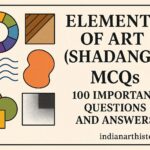
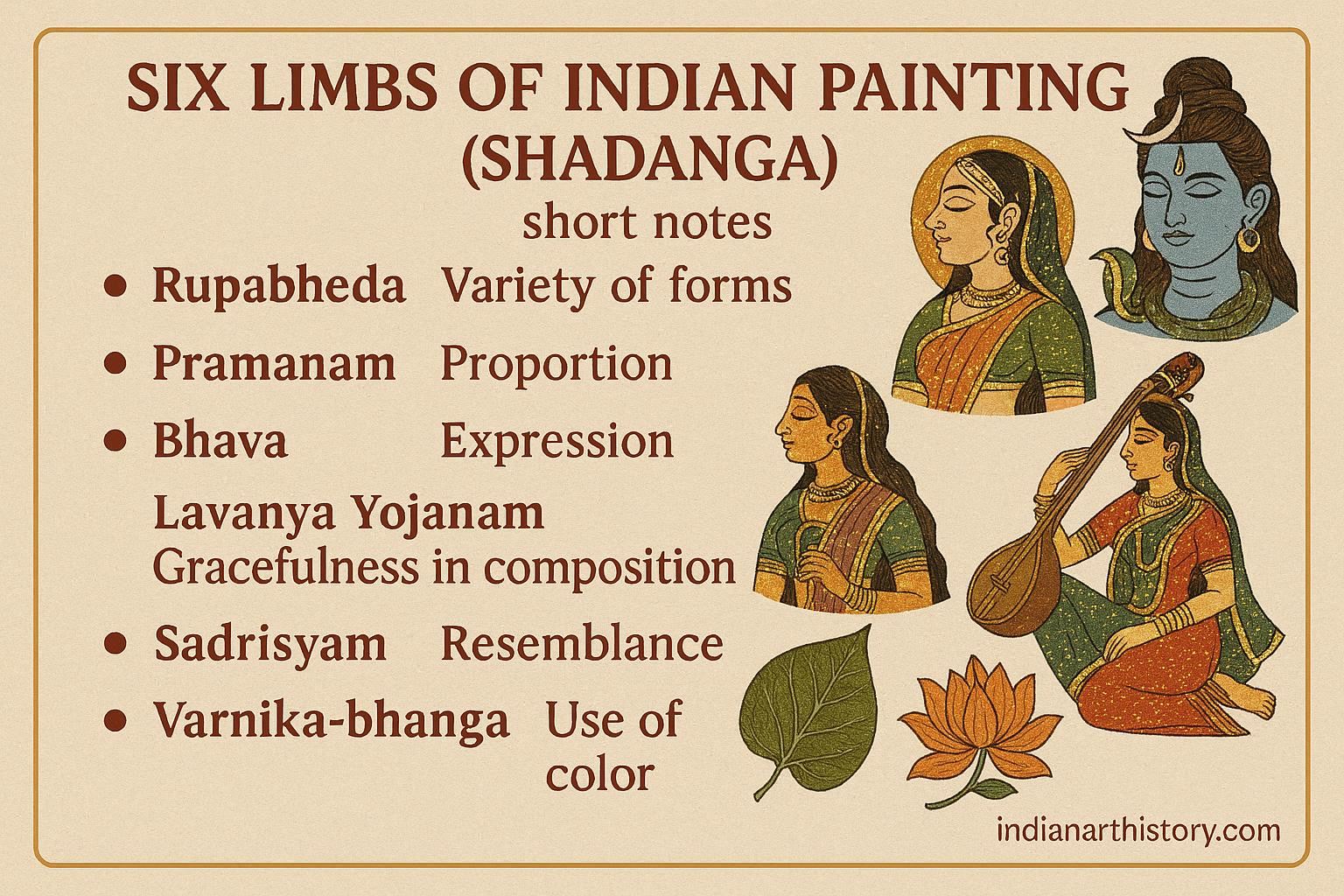
Shadanga = Six Limbs of Painting
These are the six foundational principles of classical Indian painting, described in the Chitrasutra (Vishnudharmottara Purana).
They define form, proportion, emotion, beauty, resemblance, and color technique.
1️⃣ Rupabheda (Differentiation of Forms)
- Understanding differences in forms, shapes, species, characters.
- Identifying age, gender, personality, and unique characteristics of figures.
- Helps distinguish gods, humans, animals, kings, ascetics.
- Based on observation and knowledge of anatomy.
In simple words:
What makes one form look different from another?
2️⃣ Pramanam (Proportion / Measurement)
- Deals with correct proportions, geometry, symmetry, and ratios.
- Ensures structural accuracy of body, face, posture, and architecture.
- Uses ideal body measurements described in ancient texts.
In simple words:
Correct measurement and balanced construction.
3️⃣ Bhava (Emotion / Expression)
- Depicts mood, emotion, and inner feelings.
- Expressed through posture, gestures, facial expressions, and composition.
- Creates storytelling and life in painting.
In simple words:
Emotion that makes a painting “alive”.
4️⃣ Lavanayojanam (Grace / Beauty / Aesthetic Appeal)
- Focus on elegance, charm, and harmony of forms.
- Smooth lines, beautiful curves, pleasing ornamentation.
- Adds visual appeal and artistic refinement.
In simple words:
Beauty and gracefulness of the artwork.
5️⃣ Sadrishyam (Resemblance / Likeness to Nature)
- Ensures accurate likeness of the subject.
- Important for realistic depiction within traditional style.
- The painting must resemble the intended object or person.
In simple words:
Does it look like what it’s supposed to represent?
6️⃣ Varnikabhanga (Coloring Technique / Use of Pigments)
- Knowledge of natural pigments, color harmony, and their application.
- Includes shading, blending, layering, and brush technique.
- Creates depth, texture, highlights, and realism.
In simple words:
How colors are mixed and applied on the surface.
Why Shadanga is Important
- It is the foundation of Indian painting theory.
- Provides a scientific + aesthetic system for creating complete artwork.
- Balances realism (form, proportion) with beauty (grace) and emotion (bhava).
- Influenced Ajanta, Pattachitra, Rajput, Mughal, and other schools of painting.
One-Page Memory Chart
| No. | Sanskrit Term | Meaning | Quick Memory Hint |
|---|---|---|---|
| 1 | Rupabheda | Differentiation of forms | What shape is it? |
| 2 | Pramanam | Proportion | Are the measurements correct? |
| 3 | Bhava | Emotion | What mood does it show? |
| 4 | Lavanayojanam | Grace | How beautiful does it look? |
| 5 | Sadrishyam | Resemblance | Does it look real? |
| 6 | Varnikabhanga | Color technique | How are colors applied? |
Exam Tip
A repeated question in TGT/PGT/NET:
“Who explained the Six Limbs of Painting?”
✔ Answer: Chitrasutra of Vishnudharmottara Purana
Another common question:
“Which limb deals with emotion?”
✔ Bhava
“Which limb deals with color?”
✔ Varnikabhanga