
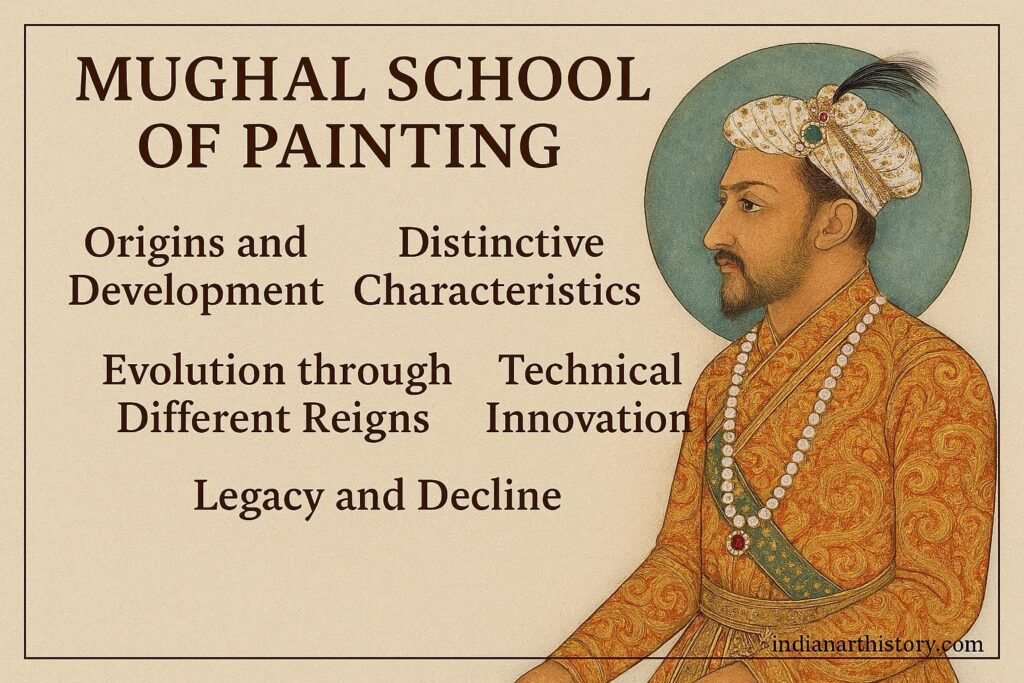
The Mughal school of painting represents one of the most sophisticated and influential artistic traditions in Indian history, flourishing from the 16th to the 19th centuries under the patronage of the Mughal emperors.
Origins and Development
The Mughal school emerged when Emperor Humayun returned from exile in Persia in 1555, bringing with him two Persian master artists, Mir Sayyid Ali and Abd al-Samad. These artists introduced Persian miniature painting techniques to India, which then blended with indigenous Indian artistic traditions to create a distinctive new style. The synthesis truly flourished under Humayun’s son, Akbar the Great, who established royal ateliers where Persian, Indian, and eventually European artistic influences merged.
Distinctive Characteristics
Mughal paintings are characterized by their meticulous attention to detail, naturalistic representation, and refined use of color. Unlike the flat, stylized figures of earlier Indian painting traditions, Mughal art introduced three-dimensionality, perspective, and individualized portraiture. The artists employed delicate brushwork, often using a single squirrel-hair brush, and worked with natural pigments ground from minerals, vegetables, and precious stones. Gold and silver were frequently used to add luminosity and richness.
The subject matter was diverse, ranging from historical chronicles and court scenes to portraits, natural history studies, and literary illustrations. Albums of paintings, or muraqqa, became popular formats for collecting and displaying these works.
Evolution Through Different Reigns
Under Akbar, the focus was on illustrating great literary works like the Hamzanama, Razmnama (Persian translation of the Mahabharata), and Akbarnama. His workshops employed over a hundred artists, both Muslim and Hindu, working collaboratively.
Jahangir’s reign saw a shift toward more refined portraiture and natural history studies. This emperor had a keen interest in the natural world, commissioning detailed studies of birds, animals, and flowers with scientific precision. Portraiture reached new heights of psychological insight during this period.
Shah Jahan’s era emphasized formality, elegance, and architectural precision. Court scenes became more ceremonial, and the aesthetic leaned toward greater refinement and luxury, though some argue it lost some of the vitality of earlier periods.
Technical Innovation
Mughal artists developed sophisticated techniques including the use of burnishing to create smooth, jewel-like surfaces, and the application of multiple thin layers of transparent color to achieve luminous effects. They also pioneered the practice of detailed preliminary drawings, division of labor among specialists (colorists, portraitists, landscape artists), and the incorporation of European artistic techniques like shading and perspective after exposure to European prints and paintings.
Legacy and Decline
The Mughal school began to decline in the 18th century as imperial patronage weakened. However, its influence persisted, inspiring regional schools like the Rajasthani and Pahari traditions, and continuing to shape Indian artistic sensibilities. Today, Mughal miniatures are treasured in major museums worldwide and continue to influence contemporary Indian artists, standing as testaments to a remarkable cultural synthesis that defined an era.