
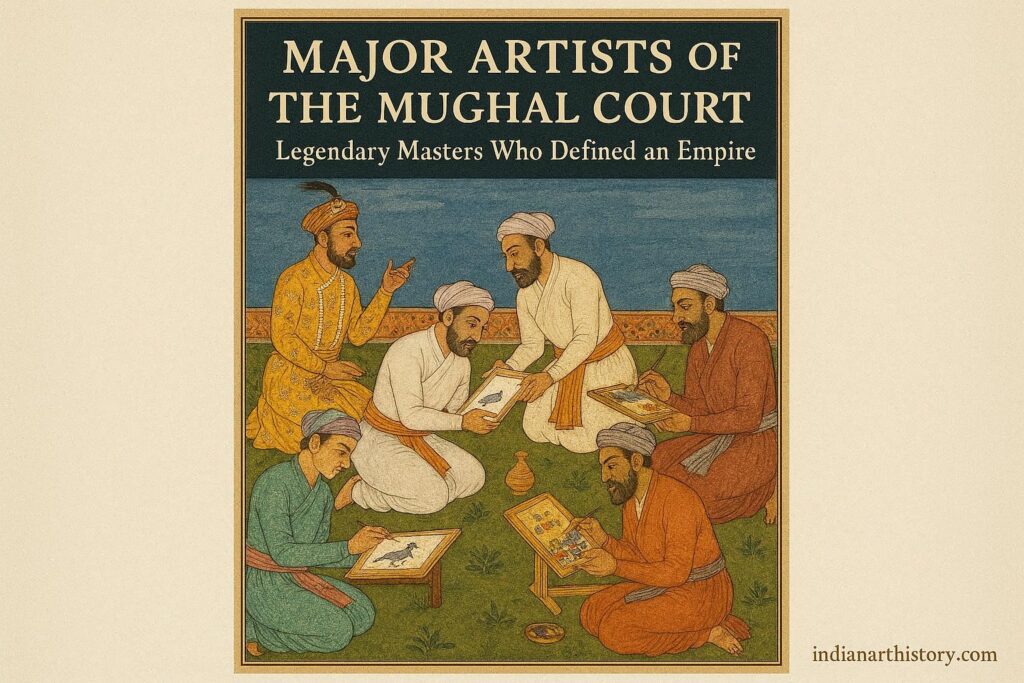
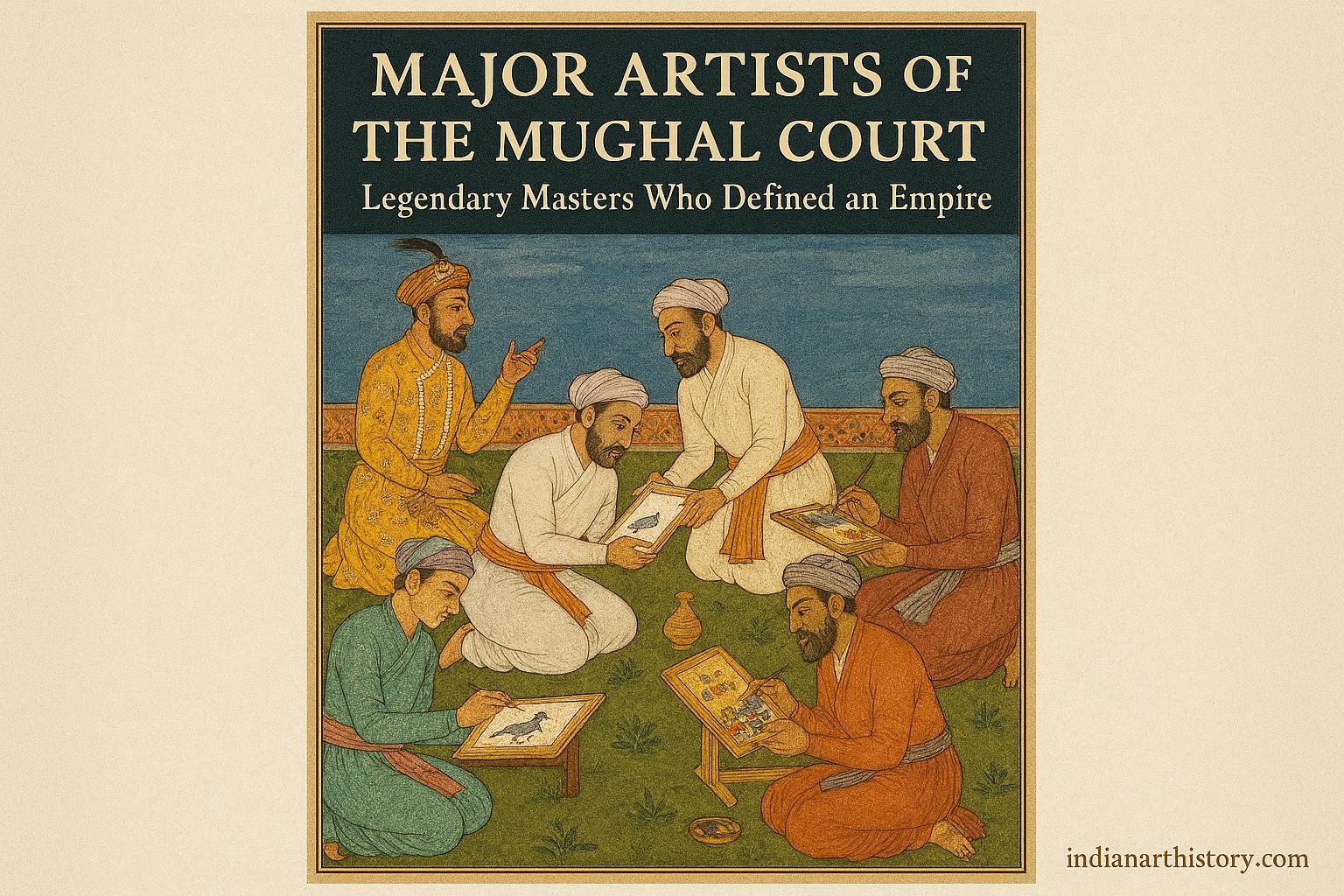
Major artists of the Mughal court shaped India’s greatest miniature painting tradition, blending Persian finesse with Indian realism under imperial patronage.
Table of Contents
Introduction to the Mughal Painting Tradition
The major artists of the Mughal court played a decisive role in shaping one of the most sophisticated visual traditions in world art history. Flourishing between the 16th and 18th centuries, Mughal painting emerged as a refined courtly art that blended Persian elegance with Indian realism. It wasn’t just about decoration—it was about power, documentation, devotion, and storytelling.
From imperial ateliers buzzing with creativity to richly illustrated manuscripts commissioned by emperors, Mughal painters worked under royal patronage that encouraged innovation. As a result, the major artists of the Mughal court produced works that still captivate scholars, students, and art lovers today.
Historical Background of Mughal Court Art
Persian Roots and Indian Synthesis
The Mughal painting tradition began when Emperor Humayun invited Persian masters to India. These artists brought with them Safavid techniques—fine lines, luminous colors, and detailed compositions. Over time, Indian sensibilities merged with Persian styles, giving birth to a uniquely Mughal aesthetic.
Royal Patronage and Imperial Workshops
Imperial workshops, known as karkhanas, were organized spaces where artists collaborated on large projects. Each artist had a role—drawing, coloring, or finishing details. This collaborative system allowed the major artists of the Mughal court to experiment and excel.
Key Characteristics of Mughal Court Painting
Techniques, Materials, and Themes
Mughal artists used mineral pigments, gold, and fine brushes made from squirrel hair. Themes ranged from royal hunts and battles to court scenes and portraits. Precision and realism became hallmarks of the style.
Albums, Manuscripts, and Murals
Illustrated manuscripts like the Hamzanama and imperial albums (muraqqas) showcased the talent of the major artists of the Mughal court. These works weren’t merely artistic—they were historical records.
Abdus Samad: The Imperial Pioneer
Early Contributions under Humayun
Abdus Samad was among the first major artists of the Mughal court. Trained in Persia, he joined Humayun’s court and later served Akbar. His role extended beyond painting—he supervised imperial workshops.
Artistic Style and Legacy
Known for elegant compositions and refined detailing, Abdus Samad laid the foundation for Mughal miniature painting. His leadership shaped generations of court artists.
Mir Sayyid Ali: Architect of Mughal Miniature
Persian Influence and Training
Mir Sayyid Ali, another Persian master, was instrumental in developing Mughal painting. His Persian training influenced early Mughal manuscripts.
Manuscript Illustration Mastery
He contributed significantly to the Hamzanama, one of the largest illustrated manuscripts in the world. His work exemplifies the early brilliance of the major artists of the Mughal court.
Basawan: The Genius of Realism
Naturalism and Psychological Depth
Basawan stands out for introducing realism and emotional depth. His figures show individuality, not just idealized forms.
Basawan’s Workshop and Influence
He trained many artists, including his son Manohar. Basawan’s influence reshaped Mughal art, making him one of the most celebrated major artists of the Mughal court.
Daswanth: The Tragic Prodigy
Mythological Narratives
Daswanth was known for dramatic mythological scenes. His compositions were bold and expressive.
Emotional Intensity in Mughal Art
Despite his short life, Daswanth’s emotional intensity left a lasting mark. Akbar himself admired his talent, placing him among the greatest major artists of the Mughal court.
Miskin: The Master of Portraiture
Court Life and Genre Scenes
Miskin specialized in portraits and everyday court scenes. His works provide valuable insights into Mughal social life.
Mughal Albums and Portrait Studies
His contributions to royal albums highlight his skill in capturing likeness and mood.
Govardhan: Artist of Refinement
Subtlety, Grace, and Court Elegance
Govardhan’s art reflects refinement and grace. His portraits are calm, balanced, and elegant.
Transition toward Late Mughal Style
He played a key role during Jahangir’s reign, bridging early and late Mughal styles.
Bishandas: Diplomatic Visual Historian
Portraits of Foreign Courts
Bishandas accompanied diplomatic missions, painting foreign rulers and landscapes.
Documentary Realism
His work adds a global dimension to Mughal art, reinforcing the importance of the major artists of the Mughal court in world history.
Role of Women and Anonymous Artists
While records often highlight male artists, many anonymous contributors, including women, worked behind the scenes. Their collective efforts sustained Mughal artistic excellence.
Mughal Court Art under Jahangir and Shah Jahan
Jahangir emphasized naturalism and portraiture, while Shah Jahan favored elegance and architectural harmony. Under their patronage, the major artists of the Mughal court reached new heights.
Decline and Legacy of Mughal Court Painting
With the decline of imperial patronage, Mughal painting gradually faded. However, its legacy continued in Rajput and Pahari schools. Today, museums worldwide preserve these masterpieces.
For further reading, see Encyclopaedia Britannica’s overview of Mughal painting: https://www.britannica.com/art/Mughal-painting
FAQs
1. Who were the major artists of the Mughal court?
Key figures include Abdus Samad, Mir Sayyid Ali, Basawan, Daswanth, Miskin, Govardhan, and Bishandas.
2. Why is Mughal court painting important?
It represents a unique fusion of Persian and Indian art, influencing later Indian painting traditions.
3. Which emperor supported Mughal painting the most?
Emperor Akbar provided the strongest patronage, organizing imperial workshops.
4. What themes did Mughal artists paint?
Royal life, battles, portraits, mythology, and nature were common themes.
5. How did Mughal painting influence later art?
It inspired Rajput, Deccan, and Pahari schools of painting.
6. Where can Mughal paintings be seen today?
Major collections are housed in museums in India, the UK, and the USA.
Conclusion
The major artists of the Mughal court were more than painters—they were historians, innovators, and cultural architects. Their works captured the spirit of an empire and set standards that still resonate. By blending technical mastery with storytelling, they created a legacy that continues to inspire Indian art and global art history.