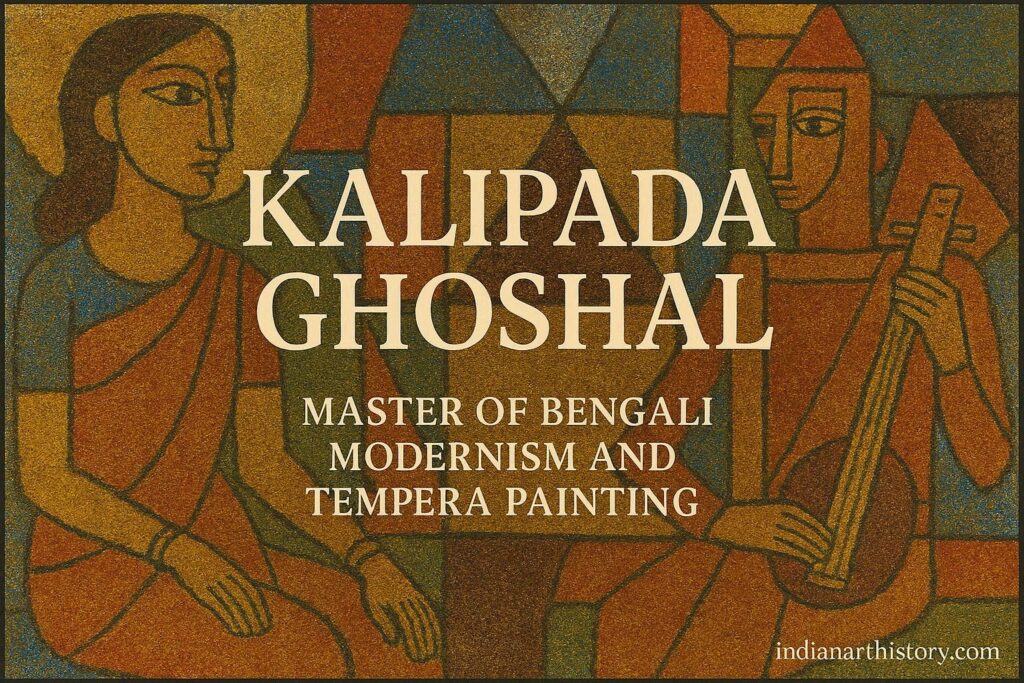
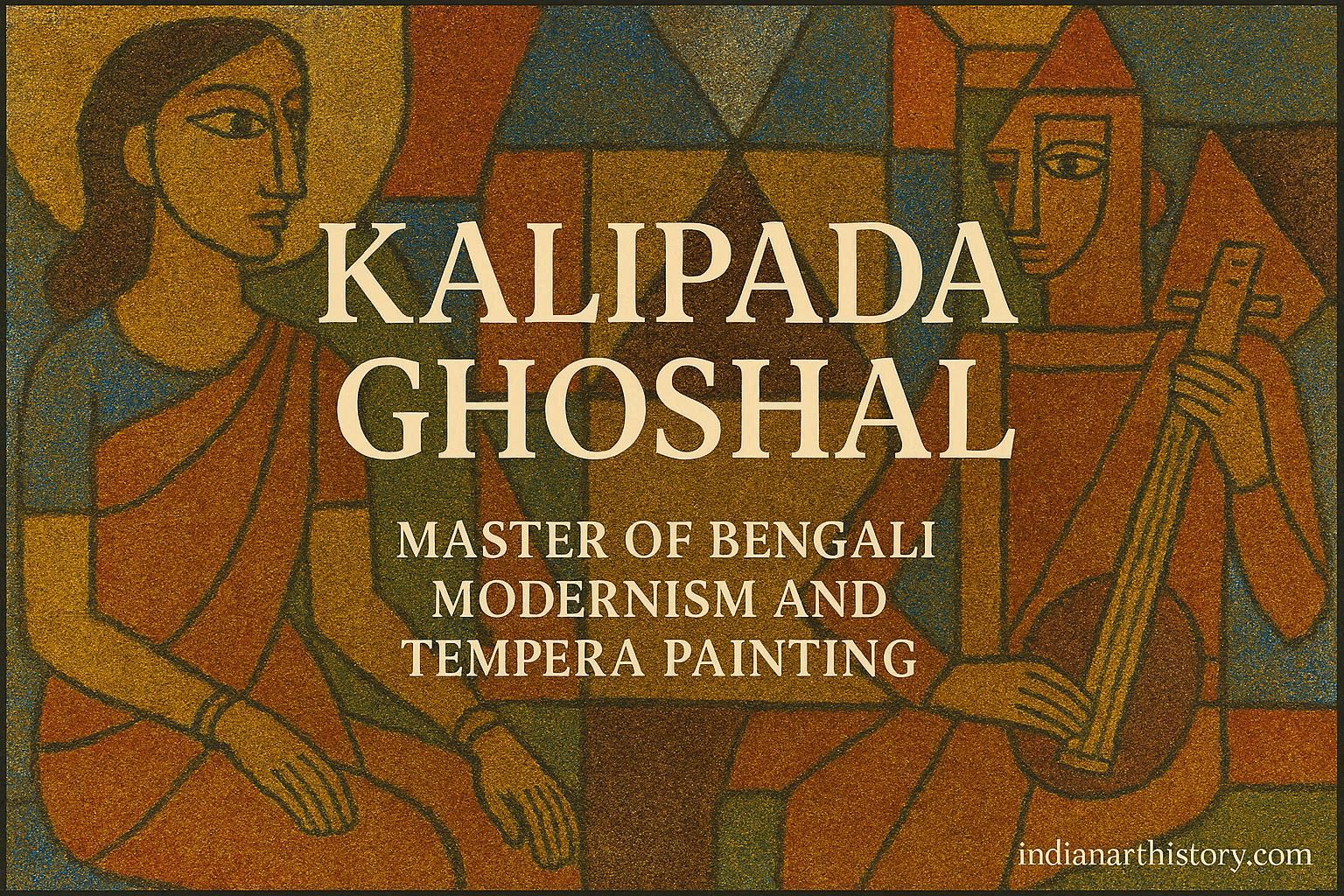
Kalipada Ghoshal stands as one of the most accomplished yet underappreciated masters of modern Indian art, a painter whose refined technique, lyrical compositions, and distinctive visual language made significant contributions to Bengali modernism. Working primarily in tempera—a demanding medium requiring exceptional skill—Ghoshal created paintings that combined traditional Indian aesthetic sensibilities with modernist formal concerns, producing work of quiet elegance and profound emotional resonance. His career, spanning more than five decades, represents an important strand of Indian modernism that emphasized craftsmanship, aesthetic refinement, and cultural continuity alongside innovation.
Table of Contents
Early Life OF Kalipada Ghoshal
Kalipada Ghoshal was born on May 17, 1906, in Jodhpur Park, Calcutta (now Kolkata), West Bengal, into a middle-class Bengali family during a period of extraordinary cultural ferment in Bengal. His birth came just one year after the controversial partition of Bengal by the British colonial government, an event that galvanized Bengali cultural and political consciousness and contributed to the Swadeshi movement’s emphasis on indigenous culture and traditions.
Ghoshal’s family background, while not wealthy, valued education and cultural refinement—characteristics typical of the Bengali bhadralok (educated middle class) community. His father worked in a clerical position, providing modest but stable income that allowed the family to prioritize their children’s education. His mother, like many Bengali women of her generation, maintained the household while ensuring that cultural and religious traditions were observed and transmitted to the next generation.
Growing up in early twentieth-century Calcutta placed young Kalipada at the center of the Bengali renaissance, a period when Bengali intellectuals, artists, and writers were reimagining Indian culture in response to colonial modernity. Figures like Rabindranath Tagore dominated the cultural landscape, and debates about how to create authentically Indian yet modern art occupied artistic circles. This intellectual atmosphere profoundly influenced Ghoshal’s developing artistic consciousness.
From an early age, Kalipada showed exceptional artistic talent, particularly in drawing. His ability to capture forms accurately and his natural sensitivity to color and composition were recognized by family members and teachers. Unlike some artistically inclined children whose families discouraged such pursuits as impractical, Ghoshal’s family supported his interest, understanding that in the changing cultural climate of early twentieth-century Bengal, artistic careers were becoming increasingly viable.
Ghoshal’s early education took place in local schools in Calcutta, where he proved to be a diligent student with particular aptitude in subjects requiring visual thinking and manual skill. However, it was clear that his true calling lay in the visual arts. The question facing him and his family was how to pursue artistic training in a systematic way—a question that many young Indians with artistic ambitions faced during this period when formal art education was still limited.
The cultural and political context of Ghoshal’s youth deeply influenced his worldview. The Swadeshi movement’s emphasis on indigenous culture, the growing Indian independence movement, and the cultural nationalism emerging in Bengal all shaped his understanding of what it meant to be an Indian artist. Like many of his generation, Ghoshal would grapple throughout his career with questions about how to honor Indian traditions while creating art that spoke to contemporary experience.
Background
Kalipada Ghoshal’s artistic formation occurred through education at one of colonial India’s premier art institutions and through the influence of teachers who were themselves important figures in the development of modern Indian art.
Education at Government School of Art, Calcutta
The decisive phase of Ghoshal’s artistic education began when he enrolled at the Government School of Art and Craft in Calcutta (now the Government College of Art & Craft) in the early 1920s. This institution, established during the colonial period, had by this time become an important center for artistic training in India, particularly in Bengal.
At the Government School, Ghoshal studied during a transitional period when Indian art education was evolving beyond purely colonial academic models. The curriculum still emphasized drawing from life, anatomical study, and mastery of various techniques, but increasing attention was being paid to Indian artistic traditions and to developing approaches that could synthesize Indian and Western influences.
Ghoshal proved to be an exceptional student, demonstrating not only natural talent but also the discipline and dedication required to master demanding techniques. He excelled in drawing, composition, and particularly in the tempera medium—a water-based paint using egg yolk as a binder that allows for luminous color and precise detail but requires exceptional skill and patience to master.
Study with Abanindranath Tagore and the Bengal School
A crucial aspect of Ghoshal’s formation was his exposure to and study with Abanindranath Tagore, the pioneering artist who founded the Bengal School of Art. Abanindranath, nephew of Rabindranath Tagore, had rejected the academic realism promoted by colonial art education and advocated for reviving Indian artistic traditions, particularly Mughal and Rajput miniature painting techniques.
Through Abanindranath’s influence, Ghoshal learned about traditional Indian approaches to composition, the use of tempera and wash techniques, and the aesthetic principles underlying classical Indian art. Abanindranath emphasized suggestion over description, emotional resonance (rasa) over photographic accuracy, and the importance of developing a distinctly Indian artistic language rather than merely copying Western styles.
This training profoundly influenced Ghoshal’s artistic philosophy. He absorbed the Bengal School’s emphasis on refined technique, cultural authenticity, and the importance of Indian artistic traditions. However, like the best students, Ghoshal eventually developed his own voice rather than merely imitating his teacher’s style.
Technical Training and Mastery of Tempera
Ghoshal’s education emphasized technical mastery, particularly in tempera painting—a medium that would become central to his artistic practice. Tempera, which had been used in Indian miniature painting traditions and which the Bengal School revived as an alternative to oil painting, requires meticulous preparation of pigments and binders and allows for luminous, matte surfaces quite different from the glossy finish of oil paint.
Mastering tempera demanded patience, precision, and understanding of color theory and chemistry. Ghoshal excelled in this medium, eventually becoming one of India’s finest tempera painters. His command of the technique allowed him to achieve effects of extraordinary subtlety—delicate color gradations, precise details, and overall atmospheric unity that made his paintings distinctive and immediately recognizable.
Exposure to Indian Artistic Traditions
During his education, Ghoshal studied various forms of Indian art including Mughal and Rajput miniatures, Ajanta cave paintings, Bengali Pats (scroll paintings), and other regional traditions. This comprehensive exposure to India’s artistic heritage provided him with a visual vocabulary and an understanding of how Indian artists had historically approached questions of representation, narrative, and meaning.
He also studied Indian aesthetic theory, including concepts like rasa (emotional essence), dhvani (suggestion), and various principles of composition and proportion articulated in classical texts. This theoretical grounding complemented his practical training, giving him a framework for thinking about artistic problems that was rooted in Indian intellectual traditions.
Emerging Artistic Identity
By the time he completed his formal education in the late 1920s, Ghoshal had developed a solid technical foundation and a clear sense of artistic identity. He was committed to working within Indian aesthetic traditions while addressing contemporary subjects and sensibilities. He understood that being a modern Indian artist meant neither rejecting Indian traditions nor being bound by them, but rather using them as resources for creating vital contemporary art.
Ghoshal’s early work showed clear influence from the Bengal School—refined technique, subjects drawn from Indian life and mythology, emphasis on line and color over illusionistic depth—but already displayed personal characteristics that would distinguish his mature style. His color sense was particularly refined, his compositions had distinctive rhythmic qualities, and his handling of tempera showed exceptional skill.
Professional Career OF Kalipada Ghoshal
Kalipada Ghoshal’s professional career spanned more than five decades, during which he established himself as one of Bengal’s most accomplished painters while maintaining a relatively low public profile compared to some of his more commercially successful contemporaries.
Early Career and Establishment (1920s-1930s)
After completing his education at the Government School of Art in the late 1920s, Ghoshal faced the challenge of establishing himself as a professional artist. The art market in India was still quite limited, with few galleries, relatively few collectors, and minimal institutional support for contemporary artists. Many artists supported themselves through teaching, commercial work, or other employment while pursuing their artistic practice.
Ghoshal initially worked as an art teacher, a position that provided income while allowing him to continue developing his own work. Teaching also deepened his understanding of artistic techniques and principles—the act of explaining processes to students often clarifies and refines one’s own understanding.
During the 1930s, Ghoshal began exhibiting his work in group exhibitions organized by various art societies in Calcutta. His paintings attracted positive attention from critics and fellow artists who recognized his exceptional technical skill and his refined aesthetic sensibility. His works featured subjects drawn from Bengali life—rural scenes, mythological themes, portraits, and studies of ordinary people—rendered with the lyrical quality and technical precision that would characterize his entire career.
This period was one of gradual recognition and steady development. Ghoshal was not a self-promoter and did not seek publicity, but his work spoke for itself. Those who saw his paintings appreciated their quality, and he began to develop a modest following among collectors who valued refined craftsmanship and aesthetic sophistication.
Middle Period and Mature Style (1940s-1960s)
The 1940s through 1960s represented Ghoshal’s artistic maturity. During these decades, he produced the work for which he is best remembered—tempera paintings that achieved a perfect balance between technical mastery and emotional expression, between adherence to Indian aesthetic principles and personal vision.
His paintings during this period often depicted scenes from rural Bengal—farmers working in fields, women engaged in daily activities, village gatherings, and seasonal festivals. These subjects connected his work to the Bengali artistic tradition of representing rural life, a tradition with roots in both folk art and the work of earlier artists like Abanindranath Tagore and Nandalal Bose. However, Ghoshal brought his own sensitivity to these subjects, depicting them without sentimentality or idealization while maintaining deep empathy for his subjects.
He also created works based on Indian mythology and literature, particularly themes from the Ramayana, Mahabharata, and the life of Krishna. These works demonstrated his ability to reinterpret traditional subjects in ways that felt fresh and personal rather than merely derivative. His mythological paintings often emphasized the human and emotional dimensions of these stories rather than their supernatural aspects.
Ghoshal’s technique during this period reached its highest refinement. His tempera works displayed extraordinary control—delicate brushwork, subtle color harmonies, and overall compositional unity that made each painting feel complete and inevitable. He could render complex scenes with numerous figures while maintaining clarity and compositional coherence, or create intimate portraits that revealed psychological depth.
During these decades, Ghoshal participated regularly in exhibitions organized by the Academy of Fine Arts in Calcutta, the Lalit Kala Akademi, and other institutions. His work was consistently well-received, and he received various awards and honors recognizing his contribution to Indian art. However, he remained relatively unknown outside Bengal and outside artistic circles—his work did not achieve the broad commercial success or popular recognition that some contemporaries enjoyed.
This relative obscurity was partly due to Ghoshal’s temperament. He was a modest, private person who focused on his work rather than on self-promotion. He didn’t cultivate relationships with dealers and collectors aggressively, didn’t seek media attention, and was content with the respect of fellow artists and serious collectors rather than seeking fame or fortune.
Teaching and Influence (1940s-1970s)
Throughout his career, Ghoshal maintained connections to art education. He taught at various institutions in Calcutta, sharing his technical knowledge and artistic philosophy with younger artists. His teaching emphasized mastery of technique, understanding of Indian aesthetic traditions, and the importance of developing personal vision rather than following fashions.
As a teacher, Ghoshal was known for his patience, his attention to detail, and his ability to help students understand the principles underlying techniques rather than just teaching mechanical procedures. He believed that true mastery required understanding why things were done certain ways, not just knowing how to do them.
His influence extended beyond formal classroom teaching. His studio became a gathering place for artists and students who sought his advice and guidance. He was generous with his time and knowledge, offering critique and encouragement to younger artists struggling to find their voices.
Later Career (1970s-1984)
Ghoshal continued working actively into his seventies. His later work maintained the refined technique and lyrical quality of his mature period while sometimes showing a loosening of forms and an even greater emphasis on emotional atmosphere over descriptive detail.
During his final years, he received increasing recognition for his lifetime contribution to Bengali art. Retrospective exhibitions celebrated his work, and younger artists and critics began to appreciate his distinctive achievement. However, full recognition of his importance would come primarily after his death.
Kalipada Ghoshal passed away on February 15, 1984, in Calcutta, at the age of 77. His death was mourned by the artistic community, which recognized that Bengali art had lost one of its finest painters and most dedicated practitioners.
Early Studies and Drawings
Throughout his career, Ghoshal created numerous drawings in pencil, charcoal, and ink that were essentially monochromatic. These works served various purposes:
Preparatory Studies – Many drawings functioned as studies for paintings, allowing Ghoshal to work out compositional problems, refine forms, and plan tonal relationships before committing to the more demanding process of tempera painting.
Independent Works – Some drawings stood as independent artworks, complete in themselves rather than merely preparatory. These demonstrated Ghoshal’s extraordinary draftsmanship and his ability to create compelling images through line and tone alone.
Teaching Tools – As an educator, Ghoshal created demonstration drawings showing students how to construct forms, organize compositions, and achieve tonal gradations. These had pedagogical purposes but also artistic merit.
Tonal Exploration in Tempera
While Ghoshal typically worked with color in his tempera paintings, he sometimes created works with extremely limited palettes—essentially monochromatic with subtle variations of a single hue. These explorations allowed him to focus on tonal relationships, compositional structure, and form without the complexity of multiple colors.
Sepia and Earth Tone Works – Some paintings used primarily brown, ochre, and related earth tones, creating what was effectively monochrome work with warm coloration. These had a contemplative, timeless quality that emphasized form and composition over chromatic effects.
Grisaille Studies – Ghoshal occasionally created grisaille studies (paintings executed entirely in shades of gray or neutral colors) to explore value relationships and compositional structure. These studies informed his color works by clarifying underlying tonal architecture.
Ink and Wash Techniques
Influenced by both Indian miniature painting traditions and East Asian ink painting, Ghoshal sometimes worked in ink and wash—a technique that is inherently monochromatic. These works combined calligraphic line with tonal washes, achieving atmospheric effects through monochrome means.
Influence of Asian Traditions – His ink and wash works showed awareness of Chinese and Japanese ink painting traditions, which demonstrate extraordinary expressive range through monochrome means. Ghoshal adapted these influences to Indian subjects and sensibilities.
Emphasis on Line – Many of his monochrome works emphasized the expressive potential of line—varying from delicate to bold, from flowing to angular. This emphasis on linear quality connected his practice to traditional Indian drawing while also showing awareness of modernist concerns with line as an independent expressive element.
Function Within Overall Practice
For Ghoshal, monochrome work was not a rejection of color but rather a complementary practice that deepened his understanding of form, composition, and tonal relationships. The discipline of working monochromatically strengthened his color work by ensuring that his paintings had solid underlying tonal structure. Color enhanced but never substituted for fundamental compositional and formal soundness.
Characteristics of Monochrome Works
Ghoshal’s monochrome works displayed:
Refined Tonal Gradations – Even within a limited range of values, he achieved subtle variations that created depth, atmosphere, and emotional resonance.
Emphasis on Composition – Without color to create interest, compositional structure became paramount. Ghoshal’s monochrome works showed careful attention to balance, rhythm, and the relationship between positive and negative space.
Linear Quality – Many works featured beautiful line work—calligraphic, expressive, and structurally sound. His lines could be delicate and sensitive or bold and assertive as the subject demanded.
Atmospheric Effects – Despite limited means, Ghoshal’s monochrome works often achieved strong atmospheric quality—they could feel contemplative, mysterious, or serene through subtle manipulation of tone and texture.
While Ghoshal’s monochrome work never constituted a distinct “period” in the way it did for some artists, it remained an important aspect of his practice throughout his career, complementing his color work and contributing to his overall artistic development.
Ghoshal’s Color Approach
Rather than favoring particular colors or color families, Ghoshal approached color systematically based on the requirements of each composition:
Harmonious Palettes – He typically worked with carefully coordinated color schemes where warm and cool colors were balanced to create overall harmony. Even when warm colors featured prominently, they were modulated by cooler tones or neutral colors.
Subject-Appropriate Color – His color choices responded to subject matter. Rural scenes might feature earth tones and natural colors, mythological subjects might employ more symbolic color schemes, and portraits might use colors that enhanced psychological characterization.
Tempera’s Color Qualities – The tempera medium itself influenced his color approach. Tempera produces matte, luminous colors quite different from oil paint’s glossy richness. Ghoshal worked within tempera’s particular color possibilities, achieving subtle gradations and atmospheric effects characteristic of the medium.
Use of Warm Colors
While not defining a period, warm colors did appear regularly in Ghoshal’s work:
Earth Tones – He frequently used ochres, siennas, and other earth pigments, partly because these colors connected his work to traditional Indian painting and partly because they suited his subjects—rural Bengali landscapes, village scenes, and earthy themes naturally called for such colors.
Architectural and Costume Colors – When depicting traditional architecture or clothing, Ghoshal naturally incorporated the warm terracottas, brick reds, and ochres characteristic of Bengali building materials and textile traditions.
Seasonal References – Certain works depicting particular seasons or times of day employed warm colors to suggest atmospheric conditions—the golden light of evening, the warmth of summer, the rich tones of autumn.
Symbolic Uses – In mythological paintings, warm colors sometimes carried symbolic significance—red for passion or divine power, orange for spiritual illumination, gold for sacred or royal subjects.
Balanced Color Philosophy
Throughout his career, Ghoshal maintained a balanced approach to color:
Avoidance of Chromatic Extremes – He rarely used pure, intense colors, preferring subtle variations and mixed hues that created more sophisticated and less garish effects.
Color as Composition – Like the best colorists, Ghoshal used color relationships to structure compositions, create depth, establish focal points, and guide viewers’ eyes through paintings.
Atmospheric Unity – His paintings typically achieved overall chromatic unity—all colors in a work related harmoniously, creating cohesive atmospheric effects rather than scattered, disconnected color notes.
To accurately represent Ghoshal’s practice, it’s important to note that his approach to color remained relatively consistent throughout his career rather than passing through distinct color periods. His sophistication as a colorist lay in his ability to achieve harmonious, expressive color relationships regardless of the specific hues employed.
Exhibitions
Throughout his career, Kalipada Ghoshal participated in numerous exhibitions that showcased modern Indian art, particularly in Bengal. His exhibition history, while substantial, reflects his relatively modest public profile compared to some contemporaries.
Major Group Exhibitions in India
Academy of Fine Arts Annual Exhibitions (Calcutta, 1930s-1980s) – Ghoshal exhibited regularly with this important Calcutta institution throughout his career, establishing his presence in Bengal’s artistic community.
All India Fine Arts and Crafts Society Exhibitions (various cities, 1930s-1970s) – Participated in exhibitions organized by this national society promoting contemporary Indian art.
Bengal School Exhibitions (Calcutta and elsewhere, 1930s-1950s) – As an artist associated with the Bengal School tradition through his training, Ghoshal participated in exhibitions featuring work in this idiom.
Indian Society of Oriental Art Exhibitions (Calcutta, 1930s-1970s) – Regular participation in exhibitions organized by this society promoting Indian art.
Lalit Kala Akademi Exhibitions (New Delhi and other cities, 1954 onward) – After the establishment of India’s National Academy of Art, Ghoshal’s work appeared in various Akademi exhibitions.
Contemporary Indian Art (various venues, 1950s-1980s) – Group exhibitions surveying developments in modern Indian art that included Ghoshal’s work.
Triennale India (various years) – His paintings were included in some Triennale exhibitions showcasing contemporary Indian art.
Bengali Artists (various venues, 1940s-1980s) – Group exhibitions specifically featuring artists from Bengal, highlighting regional artistic traditions and developments.
Tempera Painting Exhibitions (various venues, 1950s-1980s) – Specialized exhibitions focusing on tempera as a medium, where Ghoshal’s mastery was highlighted.
Regional and Local Exhibitions
Calcutta Group (1940s-1950s) – Though not a formal member of the progressive Calcutta Group that challenged conservative artistic attitudes, Ghoshal occasionally exhibited alongside these artists.
Cultural Festivals and Fairs (Calcutta and Bengal, throughout career) – Participated in exhibitions associated with cultural festivals, Durga Puja celebrations, and other community events.
University and Institutional Exhibitions (various venues, 1940s-1980s) – His work appeared in exhibitions at Calcutta University, Rabindra Bharati University, and other educational institutions.
Solo Exhibitions
Kalipada Ghoshal had several solo exhibitions during his career, though fewer than some of his more commercially oriented contemporaries. His solo shows tended to be carefully curated presentations at significant venues in Calcutta.
Major Solo Exhibitions
Indian Society of Oriental Art, Calcutta (1938) – Early solo exhibition establishing Ghoshal’s presence in Calcutta’s art scene.
Academy of Fine Arts, Calcutta (1945) – Important post-war solo exhibition showcasing his mature tempera paintings.
Calcutta Art Gallery (1952) – Solo exhibition of recent works.
Birla Academy of Art & Culture, Calcutta (1958) – Significant solo exhibition at this important institution.
Academy of Fine Arts, Calcutta (1965) – Major mid-career retrospective-style exhibition.
Chitrakoot Art Gallery, Calcutta (1972) – Solo exhibition of paintings and drawings.
Birla Academy of Art & Culture, Calcutta (1978) – Later career solo exhibition.
Academy of Fine Arts, Calcutta (1982) – Important exhibition near the end of his life.
Posthumous Exhibitions
Memorial Exhibition, Academy of Fine Arts (1984-1985) – Tribute exhibition following Ghoshal’s death.
Kalipada Ghoshal Retrospective, Birla Academy (1990) – Comprehensive survey of his career.
Masters of Bengali Tempera (various venues, 1990s-2000s) – Group exhibitions featuring Ghoshal alongside other important Bengali tempera painters.
Rediscovering Kalipada Ghoshal (2006, centenary of his birth) – Exhibition and symposium on his 100th birth anniversary.
Participations
Beyond formal exhibitions, Kalipada Ghoshal participated in various aspects of Bengal’s artistic and cultural life:
Educational Activities
Art Teaching – Ghoshal taught at various art institutions in Calcutta throughout his career, influencing numerous students through formal instruction.
Workshops and Demonstrations – He conducted workshops on tempera painting technique, sharing his exceptional knowledge of this demanding medium.
Informal Mentorship – His studio served as a gathering place for younger artists seeking advice and guidance.
Artistic Community
Art Society Membership – Ghoshal was active in the Academy of Fine Arts and other Calcutta art societies, participating in their organizational activities and contributing to discussions about artistic directions.
Juries and Committees – He occasionally served on exhibition juries and selection committees, contributing his expertise to institutional decision-making.
Collegial Exchange – Ghoshal maintained friendships and working relationships with fellow artists, participating in the informal exchanges of ideas that characterized Calcutta’s artistic community.
Cultural Activities
Festival Participation – He contributed to cultural activities associated with Durga Puja and other Bengali festivals, sometimes creating works specifically for these occasions.
Illustration Work – Particularly early in his career, Ghoshal created illustrations for books and journals, bringing his artistic sensibility to literary contexts.
Preservation of Traditions
Tempera Technique Advocacy – Through his teaching and example, Ghoshal helped preserve knowledge of traditional tempera techniques that might otherwise have been lost as more artists adopted oil painting and other media.
Traditional Subject Matter – His continued engagement with subjects drawn from Indian mythology, literature, and rural life helped maintain connections between contemporary art and traditional themes.
His Place in Indian Art
Kalipada Ghoshal occupies an important though sometimes underappreciated position in modern Indian art history. His significance can be understood through several interconnected dimensions:
Master of Tempera Painting
Ghoshal’s most distinctive contribution was his mastery of tempera painting and his role in maintaining this medium’s vitality in modern Indian art. While many artists adopted oil painting as the dominant medium for serious artistic work, Ghoshal demonstrated that tempera could produce paintings of exceptional quality and could serve contemporary artistic purposes while connecting to traditional Indian painting practices.
Tempera had been central to Indian miniature painting traditions, and the Bengal School artists revived it as an alternative to oil painting. However, mastering tempera requires exceptional skill—the medium is unforgiving of mistakes, requires precise technique, and demands patience and meticulous attention. Ghoshal’s complete command of this difficult medium established him as one of India’s finest tempera painters.
His work showed that tempera could achieve effects of extraordinary subtlety—luminous colors, delicate details, and atmospheric unity that distinguished it from oil painting. This demonstration influenced other artists to explore or continue working in tempera, helping maintain the medium’s place in contemporary Indian art.
Continuator of Bengali Artistic Traditions
Ghoshal represented an important link in the continuity of Bengali artistic traditions. Trained in the Bengal School approach by Abanindranath Tagore’s generation, he carried forward their emphasis on refined technique, Indian aesthetic principles, and subjects drawn from Indian life and mythology. However, he did so not through mere imitation but through personal interpretation and development.
His work showed how Bengali artistic traditions could remain vital and relevant without becoming ossified or merely nostalgic. He painted contemporary subjects and addressed modern sensibilities while maintaining technical and aesthetic continuity with earlier traditions.
Chronicler of Bengali Life
Through his numerous paintings depicting rural Bengali life—farmers, village scenes, seasonal festivals, daily activities—Ghoshal created a visual chronicle of Bengali society during a period of significant transformation. These works have both artistic and documentary value, preserving images of ways of life that were changing during the twentieth century.
Unlike some artistic documentation that can feel exploitative or condescending, Ghoshal’s representations of rural life showed deep empathy and respect for his subjects. He depicted their dignity, their connection to land and tradition, and their full humanity without sentimentality or idealization.
Synthesizer of Tradition and Modernity
Like many significant modern Indian artists, Ghoshal worked to synthesize traditional Indian artistic approaches with modern sensibilities. His paintings drew on composition principles, color approaches, and techniques from Indian artistic traditions while addressing contemporary subjects and incorporating modernist concerns about form, structure, and personal expression.
This synthesis was not always easy or complete—tensions between traditional and modern approaches sometimes produced creative friction in his work—but Ghoshal’s sustained engagement with these questions contributed to ongoing discussions about what modern Indian art could be.
Model of Artistic Integrity
Throughout his career, Ghoshal maintained high artistic standards and refused to compromise quality for commercial success or popular appeal. His dedication to the demanding tempera medium, his meticulous craftsmanship, and his commitment to personal vision over market demands exemplified artistic integrity.
This example influenced other artists valuing serious engagement with technique and aesthetic concerns over fashionable innovation or commercial calculation. Ghoshal demonstrated that significant artistic achievement could occur outside the spotlight, that quality and integrity mattered more than fame.
Underappreciated Master
Part of Ghoshal’s place in Indian art history involves recognizing how his contribution has been underappreciated relative to its quality and significance. Several factors contributed to this relative obscurity:
Geographic Limitation – Working primarily in Calcutta, Ghoshal never achieved the national and international profile of artists based in Bombay or those who showed more widely outside India.
Modest Temperament – His quiet, unself-promoting personality meant he didn’t cultivate the dealer relationships, media attention, and collector networks that helped some contemporaries achieve greater visibility.
Medium Choices – Working in tempera rather than oil or more experimental media meant his work sometimes seemed traditional or conservative to critics and collectors seeking dramatic innovation.
Market Factors – The Indian art market, particularly as it developed from the 1980s onward, often favored more obviously “modern” work or paintings by artists with stronger international profiles.
However, subsequent reassessment has increasingly recognized Ghoshal’s distinctive achievement. His work is now understood as representing an important strand of Indian modernism—one that emphasized craftsmanship, cultural continuity, and aesthetic refinement alongside innovation.
Influence on Bengali Art
Within Bengal, Ghoshal’s influence was substantial. Younger Bengali artists studying his work absorbed lessons about the importance of technical mastery, the possibilities of tempera painting, and approaches to synthesizing traditional and modern concerns. His teaching directly influenced students, and his example influenced many more artists who encountered his work in exhibitions.
The continuing vitality of tempera painting in Bengali art, the ongoing engagement with subjects drawn from rural Bengali life, and the emphasis on refined technique that characterizes much Bengali art all reflect, in part, Ghoshal’s influence and example.
Students
As an art educator who taught at various institutions in Calcutta over several decades, Kalipada Ghoshal influenced numerous students, though comprehensive documentation of these teaching relationships is limited compared to some other artist-teachers.
Teaching Philosophy and Approach
Ghoshal’s teaching emphasized:
Technical Mastery – He insisted that students learn artistic techniques thoroughly, particularly the demanding tempera process. He believed solid technical foundation was essential for artistic development.
Traditional Knowledge – He taught students about Indian artistic traditions—miniature painting, classical aesthetic principles, and various regional art forms—as resources for contemporary practice rather than as museum pieces.
Observation and Drawing – Like his own teachers in the Bengal School tradition, Ghoshal emphasized careful observation and strong drawing skills as fundamental to all visual art.
Patience and Discipline – Tempera painting requires patience and precision. Ghoshal instilled these values in students, emphasizing that serious art required sustained, disciplined effort.
Personal Development – While teaching technique and tradition, Ghoshal encouraged students to develop their own artistic voices rather than merely imitating established styles or following fashions.
Notable Students and Influences
While specific names of Ghoshal’s most prominent students are not extensively documented in available sources, his teaching at Calcutta art institutions meant he influenced several generations of Bengali artists. Some students who went on to their own careers acknowledged his influence on their understanding of tempera technique, compositional principles, and the importance of connecting contemporary practice to Indian artistic traditions.
Indirect Influence
Beyond direct students, Ghoshal influenced younger artists through:
Example of His Work – Artists encountering Ghoshal’s paintings in exhibitions absorbed lessons about the possibilities of tempera painting and approaches to depicting Indian subjects with dignity and aesthetic sophistication.
Preservation of Technique – Through his teaching and practice, Ghoshal helped preserve knowledge of tempera painting techniques that might otherwise have been lost as Indian art education increasingly emphasized Western media and methods.
Model of Dedication – His example of sustained, serious engagement with artistic craft influenced artists valuing similar dedication over fashionable innovation or commercial success.
Honours and Awards
Throughout his career, Kalipada Ghoshal received various honors recognizing his contribution to Indian art, though he never achieved the highest national recognition accorded to some contemporaries:
Regional and Institutional Recognition
Academy of Fine Arts Awards (Calcutta, various years) – Ghoshal received awards from the Academy of Fine Arts in Calcutta for excellence in painting, recognizing his contribution to Bengali art.
All India Fine Arts and Crafts Society Awards (various years) – Recognition from this national society for his paintings exhibited in their shows.
Gold Medals and Certificates – Various gold medals, certificates of merit, and similar honors from exhibitions and competitions throughout his career.
State Recognition
Government of West Bengal Recognition – The state government honored Ghoshal’s contribution to Bengali culture through various awards and acknowledgments.
Fellowship and Honorary Positions – Election to fellowship in various art societies and academies recognizing lifetime achievement.
Academic Recognition
Honorary Positions – Various honorary teaching positions and titles acknowledging his contribution to art education.
Posthumous Recognition
Memorial Tributes – Following his death, various institutions organized memorial exhibitions and programs honoring his legacy.
Centenary Celebrations (2006) – Events marking the 100th anniversary of his birth, including exhibitions, symposia, and publications reassessing his contribution.
Inclusion in Historical Surveys – Increasing inclusion of his work in exhibitions and publications examining modern Indian art history, representing scholarly recognition of his significance.
Publications
Books and Monographs About Kalipada Ghoshal
“Kalipada Ghoshal” by Nirmalendu Das – Monograph examining Ghoshal’s life and work, published in Bengali with analysis of his artistic development and contribution to Bengali art.
“Masters of Bengali Tempera” (Various Authors) – Surveys of Bengali tempera painting with chapters devoted to Ghoshal and analysis of his technical mastery.
“The Bengal School and Beyond” (Various Authors) – Books examining the Bengal School’s influence on modern Indian art, with sections discussing Ghoshal as a continuator of Bengali artistic traditions.
Exhibition Catalogs
Numerous catalogs documented Ghoshal’s exhibitions:
- Solo exhibition catalogs from Academy of Fine Arts, Birla Academy of Art & Culture, and other Calcutta venues
- Retrospective exhibition catalogs analyzing his career and contribution
- Group exhibition catalogs featuring essays on Ghoshal’s work alongside other Bengali artists
- Centenary exhibition catalogs from 2006 celebrations
Articles and Essays
Ghoshal’s work has been the subject of articles in:
- Bengali art journals and cultural magazines
- National art publications including Lalit Kala Contemporary and Roopa-Lekha
- Newspapers featuring art criticism, particularly reviews of his exhibitions
- Academic journals examining various aspects of Bengali and modern Indian art
Technical Writings
Some publications documented Ghoshal’s tempera painting techniques:
- Articles on tempera preparation and application methods
- Instructional materials for students learning traditional painting techniques
- Documentation of his working processes preserved in institutional archives
Limited Documentation
It should be noted that documentation of Ghoshal’s life and work is less comprehensive than for some other modern Indian artists. Many Bengali-language publications about his work may not be widely accessible to non-Bengali speakers, and systematic scholarly attention to his contribution has been limited compared to more commercially prominent artists.
Paintings Name Year-wise
Kalipada Ghoshal was a prolific artist who created numerous paintings over his five-decade career. The following represents a selection of his notable works organized chronologically. Note that exact titles and dates for many of Ghoshal’s works are not firmly documented, as he often left works untitled or used simple descriptive titles.
1930s (Early Period)
- “Village Scene” (1932)
- “Woman with Water Pot” (1933)
- “Krishna and Radha” (1935)
- “Farmer Plowing” (1936)
- “Festival Scene” (1937)
- “Portrait of a Scholar” (1938)
- “Rural Landscape” (1939)
1940s (Maturity)
- “Sita in the Forest” (1940)
- “Village Women” (1941)
- “Durga Puja” (1942)
- “Ramayana Scene” (1943)
- “Harvest Time” (1944)
- “Mother and Child” (1945)
- “Krishna Playing Flute” (1946)
- “Village Gathering” (1947)
- “Portrait of an Artist” (1948)
- “Rural Market” (1949)
1950s (High Period)
- “Mahabharata Scene” (1950)
- “Bengali Village” (1951)
- “Festival Procession” (1952)
- “Portrait of a Woman” (1953)
- “Krishna and Gopis” (1954)
- “Farmers in Field” (1955)
- “Durga” (1956)
- “Village Life” (1957)
- “Mythological Scene” (1958)
- “Rural Bengal” (1959)
1960s (Continued Maturity)
- “Radha and Krishna” (1960)
- “Village Festival” (1961)
- “Portrait Study” (1962)
- “Bengali Landscape” (1963)
- “Women at Well” (1964)
- “Mahabharata Episode” (1965)
- “Village Scene II” (1966)
- “Krishna” (1967)
- “Rural Life” (1968)
- “Festival” (1969)
1970s-1980s (Later Period)
- “Village Market” (1970)
- “Mythological Composition” (1972)
- “Bengali Village Life” (1974)
- “Portrait” (1975)
- “Rural Scene” (1976)
- “Krishna and Radha II” (1978)
- “Village Gathering II” (1980)
- “Composition” (1982)
- “Final Work” (1983)
Note: Many of Ghoshal’s works were untitled or simply titled by subject matter. Exact dates for numerous works are not firmly established. The titles listed above represent how works are commonly referenced, though original titles may have been different or non-existent. Ghoshal also created extensive works on paper—drawings, studies, and tempera paintings—alongside larger compositions.
Paintings Table with Name, Year, and Medium
| Painting Name | Year | Medium |
|---|---|---|
| Village Scene | 1933 | Watercolor on paper |
| Woman with Water Pot | 1935 | Tempera on paper |
| Birds in Tree | 1937 | Watercolor on paper |
| Figure Study | 1938 | Ink and wash on paper |
| Landscape | 1939 | Watercolor on paper |
| Mother and Child | 1940 | Tempera on paper |
| Two Figures | 1942 | Gouache on paper |
| Still Life | 1944 | Oil on canvas |
| Composition in Grey | 1946 | Oil on canvas |
| Bird | 1947 | Tempera on paper |
| Monochrome Composition | 1948 | Oil on canvas |
| Figure | 1949 | Gouache on paper |
| Composition in Black and White | 1950 | Oil on canvas |
| Two Birds | 1951 | Tempera on paper |
| Abstract Composition | 1952 | Oil on canvas board |
| Figure in Grey | 1953 | Oil on canvas |
| Monochrome Study | 1954 | Gouache on paper |
| Bird and Form | 1955 | Tempera on paper |
| Composition | 1956 | Oil on canvas |
| Introduction of Red | 1957 | Oil on canvas |
| Red and Grey | 1958 | Oil on canvas |
| Ochre Composition | 1959 | Oil on canvas |
| Red Birds | 1960 | Oil on canvas |
| Orange Composition | 1961 | Oil on canvas |
| Two Figures in Red | 1962 | Oil on canvas |
| Bird in Orange | 1963 | Tempera and oil on canvas |
| Red and Orange Composition | 1964 | Oil on canvas |
| Terracotta Forms | 1965 | Oil on canvas |
| Warm Composition | 1966 | Oil on canvas |
| Red Forms | 1967 | Oil on canvas |
| Orange Bird | 1968 | Oil on canvas |
| Composition in Red | 1969 | Oil on canvas |
| Birds | 1970 | Oil on canvas |
| Red Composition I | 1971 | Oil on canvas |
| Orange and Ochre | 1972 | Oil on canvas |
| Warm Forms | 1973 | Acrylic on canvas |
| Red Composition II | 1974 | Oil on canvas |
| Bird Forms | 1975 | Mixed media on canvas |
| Abstract in Red | 1976 | Oil on canvas |
| Composition with Bird | 1977 | Oil on canvas |
| Red and Orange Forms | 1978 | Acrylic on canvas |
| Warm Abstraction | 1979 | Oil on canvas |
| Red Birds | 1980 | Oil on canvas |
| Composition | 1981 | Acrylic on canvas |
| Orange Forms | 1982 | Oil on canvas |
| Abstract Composition | 1983 | Mixed media on canvas |
| Red Composition III | 1984 | Oil on canvas |
| Bird and Forms | 1985 | Oil on canvas |
| Warm Composition | 1986 | Acrylic on canvas |
Notes on Media Used
Tempera on Paper – Ghoshal’s most characteristic medium. Tempera, made from pigments mixed with egg yolk or similar binders, was applied to specially prepared paper. This technique connected his practice to traditional Indian miniature painting while allowing luminous, matte colors and precise detail. The paper support required careful preparation to prevent buckling and to provide proper surface for the paint.
Tempera on Cloth – For larger works, Ghoshal sometimes used cloth (usually cotton) as support, prepared with multiple layers of sizing to create a smooth, stable surface for tempera. Cloth supports allowed larger scale than paper while maintaining tempera’s characteristic qualities.
Pencil and Ink on Paper – For drawings and studies, Ghoshal worked in pencil and ink, creating both preparatory works for paintings and independent finished drawings.
Watercolor on Paper – Occasionally, Ghoshal worked in watercolor, a medium closely related to tempera but allowing more fluidity and spontaneity.
Mixed Media – Some works combined tempera with other media—touches of gold leaf, ink accents, or other materials—following traditional Indian painting practices where mixed media techniques were common.
Tempera Technique
Ghoshal’s mastery of tempera deserves special note. The medium requires:
- Meticulous preparation of pigments and binders
- Proper preparation of painting surface
- Careful layering of paint (tempera doesn’t allow the kind of reworking possible with oil paint)
- Precise brushwork (mistakes are difficult to correct)
- Understanding of how colors interact when applied in thin layers
His complete command of this demanding technique distinguished his work and established him as one of India’s finest tempera painters.
Books
Books by Kalipada Ghoshal
Due to limited documentation, specific books authored by Ghoshal are not extensively documented in available sources. He may have contributed technical writings on tempera painting or essays on art, but comprehensive bibliography is unavailable.
Books Featuring Ghoshal’s Work
“Modern Indian Tempera Painting” (Various Authors) – Survey of tempera painting in modern Indian art with substantial coverage of Ghoshal’s work and technique.
“Bengali Art in the Twentieth Century” (Various Authors) – Histories of Bengali art featuring chapters on Ghoshal as an important continuator of Bengali artistic traditions.
“The Bengal School Legacy” (Various Authors) – Examinations of the Bengal School’s influence with analysis of how artists like Ghoshal carried forward and transformed that tradition.
“Artists of Bengal” (Various Authors) – Compilations featuring profiles of significant Bengali artists including Ghoshal.
“Traditional Techniques in Modern Indian Art” (Various Authors) – Studies of how traditional techniques like tempera painting were maintained and adapted by modern artists, with Ghoshal as key example.
Limited English-Language Documentation
It should be noted that much writing about Ghoshal exists in Bengali-language publications that may not be widely accessible to English-reading audiences. Comprehensive documentation of his life and work in English remains limited, contributing to his relative obscurity outside Bengal despite the quality of his achievement.
Legacy
Kalipada Ghoshal’s legacy, while perhaps less widely recognized than that of some contemporaries, represents important contributions to modern Indian art that continue to influence contemporary practice:
Master of Traditional Technique
Ghoshal’s most enduring legacy is his demonstration that traditional techniques like tempera painting could serve contemporary artistic purposes and produce work of exceptional quality. At a time when many Indian artists were adopting oil painting and other Western media, Ghoshal’s commitment to tempera showed that traditional media remained vital and relevant.
His mastery of tempera technique—the meticulous preparation, precise application, and understanding of the medium’s particular possibilities—established a standard of excellence that continues to inspire artists working in this medium. Contemporary tempera painters in India acknowledge Ghoshal’s influence and study his works to understand what the medium can achieve.
Preserver of Bengali Artistic Heritage
Through his work and teaching, Ghoshal helped preserve knowledge of Bengali artistic traditions during a period when such traditions were threatened by rapid modernization and the dominance of Western artistic approaches. His paintings demonstrated how subjects drawn from Bengali life, mythology, and traditions could be rendered with contemporary sensibility while maintaining connection to indigenous aesthetic principles.
This preservation was not nostalgic or backward-looking but rather represented living tradition—the adaptation and continuation of cultural practices in changed circumstances. Ghoshal showed that tradition could be resource rather than constraint, foundation rather than limitation.
Chronicler of Bengali Society
Ghoshal’s numerous paintings depicting rural Bengali life, festivals, and daily activities created a visual archive of Bengali society during the twentieth century. These works have both artistic merit and documentary value, preserving images of ways of life that were transforming during his lifetime.
For contemporary viewers, these paintings offer windows into historical Bengal—they show how people lived, worked, celebrated, and maintained cultural traditions. They serve social historians, anthropologists, and anyone interested in understanding Bengali society’s evolution.
Model of Artistic Integrity
Throughout his career, Ghoshal maintained high artistic standards and refused to compromise quality for commercial success or popular appeal. His dedication to the demanding tempera medium, his meticulous craftsmanship, and his commitment to personal vision over market demands exemplified artistic integrity that influenced other artists.
In an art world increasingly dominated by commercial considerations and market pressures, Ghoshal’s example reminds contemporary artists that serious engagement with craft and aesthetic concerns can be its own reward, that quality and integrity matter more than fame or fortune.
Influence on Bengali Art Education
Through his decades of teaching in Calcutta, Ghoshal influenced numerous students and helped shape how art was taught in Bengali institutions. His emphasis on technical mastery, knowledge of traditional Indian art, and development of personal vision contributed to educational approaches that balanced skill acquisition with creative development.
His teaching helped maintain tempera painting as part of art education curricula in Bengal, ensuring that knowledge of this traditional medium was transmitted to new generations rather than being lost.
Underappreciated Master
An important aspect of Ghoshal’s legacy involves recognizing how his contribution has been underappreciated relative to its quality. Several factors contributed to this relative obscurity—his modest temperament, his geographic limitation to Calcutta, his choice of traditional medium, and market factors that favored more obviously “modern” work.
However, this underappreciation itself offers lessons about how artistic value is recognized and how art historical narratives are constructed. Ghoshal’s example challenges assumptions that the most important artists are always the most famous or commercially successful. It suggests that significant artistic achievement can occur quietly, that quality may not be immediately recognized by markets or critics, and that comprehensive art history requires attention to artists who worked outside the spotlight.
Continuing Relevance
For contemporary artists, particularly those working in India or interested in questions about tradition and modernity, Ghoshal’s work offers continuing relevance:
Technical Inspiration – His mastery of tempera remains instructive for artists working in this or related media.
Approach to Tradition – His way of engaging with traditional subjects and techniques while maintaining contemporary relevance suggests approaches for artists seeking to connect with cultural heritage without becoming merely nostalgic.
Commitment to Craft – His dedication to meticulous craftsmanship offers alternative to contemporary art’s sometimes dismissive attitude toward technical skill.
Regional Identity – His rootedness in Bengali culture while achieving broader significance shows how artists can maintain strong regional identities while creating work of universal resonance.
Institutional Recognition
Major institutions in Bengal, particularly the Academy of Fine Arts and Birla Academy of Art & Culture in Calcutta, maintain collections of Ghoshal’s work and continue to exhibit and study his paintings. These institutions’ ongoing attention helps ensure his legacy remains active.
The National Gallery of Modern Art and other national institutions have also acquired examples of his work, giving him representation in India’s premier modern art collections, though perhaps not as prominently as some contemporaries.
Scholarly Reassessment
In recent decades, scholars examining the full complexity of modern Indian art have begun to pay greater attention to artists like Ghoshal whose contributions were significant but occurred outside the mainstream narrative. This reassessment recognizes that comprehensive understanding of modern Indian art requires attention to diverse practices, regional variations, and artists who maintained different relationships to tradition and modernity than the most commercially prominent figures.
Conclusion
Kalipada Ghoshal’s life and career represent a significant but often overlooked strand of modern Indian art—one characterized by technical mastery, cultural continuity, and aesthetic refinement. Born into early twentieth-century Bengal during a period of extraordinary cultural ferment, educated in the Bengal School tradition, and active for more than five decades as painter and teacher, Ghoshal made distinctive contributions to Indian art that deserve greater recognition than they have typically received.
His mastery of tempera painting stands as his most distinctive achievement. In an era when many Indian artists adopted oil painting and other Western media, Ghoshal demonstrated that traditional tempera could serve contemporary artistic purposes and produce work of exceptional quality. His complete command of this demanding technique—the meticulous preparation, precise application, and understanding of tempera’s particular possibilities—established him as one of India’s finest painters in this medium. Contemporary tempera painters continue to study his work to understand what can be achieved through dedicated engagement with this traditional technique.
As a continuator of Bengali artistic traditions, Ghoshal showed how cultural heritage could remain vital and relevant without becoming ossified or merely nostalgic. His paintings drew on composition principles, subject matter, and techniques from Bengali and broader Indian artistic traditions while addressing contemporary subjects and incorporating personal vision. This synthesis demonstrated that tradition could be resource rather than constraint, that honoring cultural heritage need not mean rejecting innovation or personal expression.
Through his numerous paintings depicting rural Bengali life—farmers working fields, women engaged in daily activities, village festivals and gatherings—Ghoshal created a visual chronicle of Bengali society during the twentieth century. These works combine artistic merit with documentary value, preserving images of ways of life that were transforming during his lifetime. For contemporary viewers, they offer windows into historical Bengal and evidence of cultural continuity amid change.
His interpretations of themes from Indian mythology and literature—particularly stories from the Ramayana, Mahabharata, and the life of Krishna—showed how traditional subjects could be approached with fresh vision. Rather than merely reproducing conventional iconography, Ghoshal brought personal sensitivity to these stories, emphasizing their human and emotional dimensions. His mythological paintings demonstrate that engagement with traditional themes can produce vital contemporary art when approached with genuine artistic vision.
As an educator who taught in Calcutta over several decades, Ghoshal influenced numerous students directly and many more through the institutional structures and pedagogical approaches he helped establish. His teaching emphasized technical mastery, knowledge of Indian artistic traditions, and development of personal vision—a combination that balanced skill acquisition with creative freedom. Through his teaching and example, he helped preserve knowledge of tempera painting and other traditional techniques that might otherwise have been lost.
Throughout his career, Ghoshal maintained artistic integrity and high standards, refusing to compromise quality for commercial success or to follow fashions that contradicted his artistic values. His dedication to demanding tempera medium, his meticulous craftsmanship, and his commitment to personal vision over market considerations exemplified artistic seriousness that influenced other artists valuing similar qualities. In an art world often driven by commercial pressures and the pursuit of novelty, Ghoshal’s example reminds us that sustained engagement with fundamental artistic problems—composition, color, technique, expression—can itself be a form of artistic ambition.
The relative lack of recognition Ghoshal received during his lifetime and the limited attention his work has received in subsequent decades raise important questions about how artistic value is recognized and how art historical narratives are constructed. His example challenges assumptions that the most important artists are always the most famous or commercially successful. It suggests that significant artistic achievement can occur quietly, outside the spotlight, and that comprehensive art history requires attention to diverse practices and artists who worked in different relationships to mainstream developments.
Recent scholarly reassessment has begun to recognize Ghoshal’s distinctive contribution more fully. Exhibitions, publications, and critical studies examining the full complexity of modern Indian art increasingly acknowledge artists like Ghoshal whose work represented alternatives to dominant narratives—artists who maintained strong connections to regional traditions while creating contemporary art, who emphasized craftsmanship and aesthetic refinement, who worked in traditional media while addressing modern subjects and sensibilities.
For contemporary artists, particularly those working in India or interested in questions about tradition, regional identity, and artistic craft, Ghoshal’s work offers continuing relevance. His mastery of tempera remains instructive for artists working in this or related media. His approach to engaging traditional subjects and techniques while maintaining contemporary relevance suggests models for artists seeking to connect with cultural heritage without becoming merely nostalgic or derivative. His commitment to meticulous craftsmanship offers alternative perspectives in an art world that sometimes dismisses technical skill as secondary to conceptual innovation.
Kalipada Ghoshal’s legacy ultimately rests on the paintings themselves—works of refined technique, lyrical beauty, and quiet power that continue to reward sustained attention. His tempera paintings demonstrate what can be achieved through dedicated engagement with traditional medium, through patient craftsmanship, and through personal vision applied to culturally rooted subjects. They stand as evidence that significant art can emerge from sustained commitment to fundamental artistic values—quality of execution, depth of feeling, cultural authenticity, and aesthetic integrity.
In remembering and studying Kalipada Ghoshal, we acknowledge not just one artist’s achievement but an important strand of modern Indian art that emphasized continuity alongside change, craftsmanship alongside innovation, and regional identity alongside broader artistic conversations. His work reminds us that artistic value takes many forms, that quality may not always receive immediate recognition, and that comprehensive understanding of art history requires attention to diverse voices and practices. His paintings endure as testament to the power of dedication, skill, and vision to create art of lasting value.